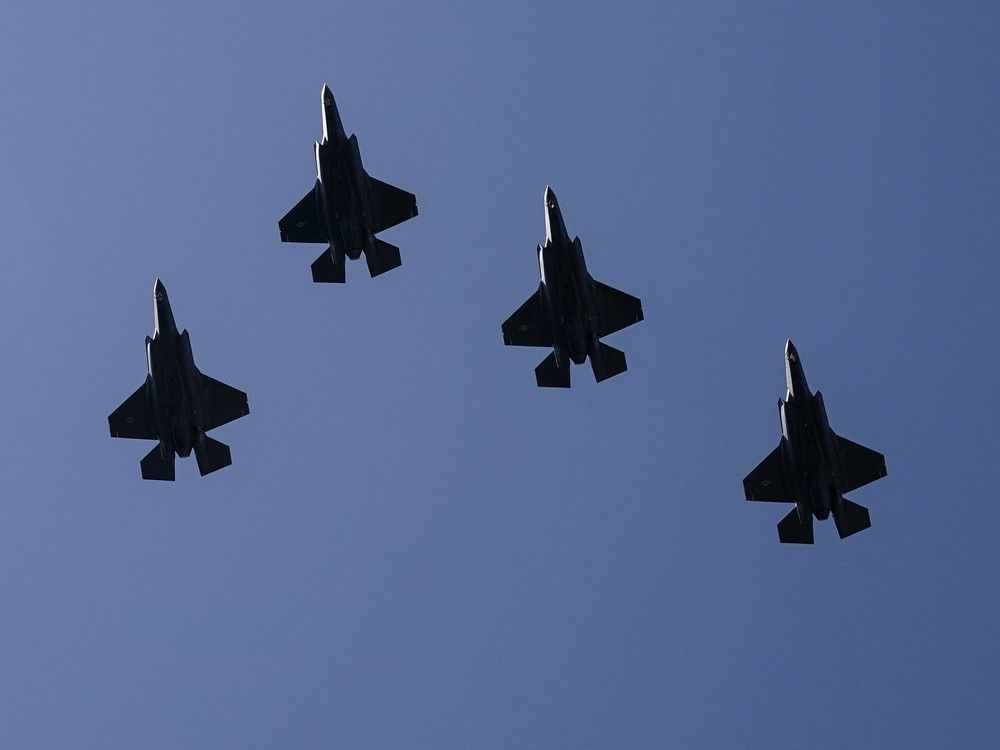
The release of the Canadian military’s review of the F-35 fighter jet is expected shortly but the U.S. has already signalled this country could face serious consequences if the Liberal government decides not to proceed with the arms deal.
Defence Minister David McGuinty
has committed to the public release of the review
which will come by the end of the summer.
“The F-35 review is still expected to be finalized by the end of summer, which, in this case, refers to the end of the calendar summer,” confirmed Department of National Defence spokesperson Alex Tétreault.
The end of the calendar summer is Sept. 20-Sept. 22 and from there the review will go to Prime Minister Mark Carney for a final decision.
On Aug. 7,
the Canadian military was recommending sticking with its proposed purchase of 88 U.S.-built F-35s. That recommendation didn’t come as a surprise for observers since the Canadian Forces originally lobbied for and selected the American fighter jet. In addition, the Canadian military leadership
is also very close to their U.S. counterparts
and has in the past pushed for further integration between the two forces.
Carney
ordered a review of the purchase
in the wake of threats against Canadian sovereignty by U.S. President Donald Trump. The U.S. has become increasingly hostile to Canada, with Trump continuing economic efforts to punish Canada and push for this country to become the 51st state.
But the U.S. government has not shied away from warning Canada that there will be consequences if the F-35 is dumped, according to defence industry insiders.
Pete Hoekstra, the U.S. ambassador to Canada,
that a decision not to buy the F-35 could threaten the joint U.S.-Canada NORAD alliance.
NORAD, he claimed, requires both the U.S. and Canada to fly the same kind of American-built planes.
“If Canadians are flying one airplane, we’re flying another airplane, it’s no longer interchangeable,” Hoekstra explained. “And so, that might even threaten NORAD.”
The U.S. also appears worried that Canada might try to buy both the F-35 as well as another non-U.S. fighter jet,
most likely the Swedish Gripen, which is manufactured by Saab.
Hoekstra warned against that. “You can’t afford two fighters, two different fighter jet programs,” Hoekstra told podcaster Jasmin Lane in an interview aired in August. “Canada should just decide what they want. Do they want F-35s? Do they want some other product? That’s your decision to make, but you can’t afford both of them.”
He also admitted that the ongoing F-35 review was “an irritant” that was making it harder to reach a trade deal between the two nations.
Supporters of the purchase of two different types of aircraft point out that with Carney’s promise to massively boost the defence budget, the Canadian military will have the funding to run additional air fleets. In addition, Gripen supporters argue that aircraft is better suited to Arctic conditions and operating from austere airfields in the far north than the F-35.
Since Carney ordered the review, there have been additional developments. The U.S. Government Accountability Office (GAO), a congressional watchdog organization,
that the F-35 fighter jet program is facing yet more delays and cost increases.
The problems centre around the F-35’s Block 4 version, the specific type that Canada plans to buy. Block 4 is at least $6 billion over budget and five years behind schedule, the GAO report said.
“After nearly 20 years of aircraft production, however, the F-35 program continues to overpromise and underdeliver,” the GAO stated.
When asked about the U.S. report, DND spokesperson Tétreault noted in an email the department “will continue to monitor the situation.”
The F-35 is seen by Canadian air force officers as an important purchase as it allows them to seamlessly integrate with their U.S. counterparts. The aircraft also further ties Canada further into the American military system
as the U.S. controls all software upgrades on the aircraft
and owns the parts for the planes, even those to be stored in Canada.
But some retired Canadian military leaders have questioned the F-35 purchase. Retired Lt.-Gen. Yvan Blondin, the air force general who originally recommended Canada buy the F-35,
has said the purchase should no longer go forward
as planned because the U.S. has become so untrustworthy.
David Pugliese is an award-winning journalist covering Canadian Forces and military issues in Canada. To support his work, including exclusive content for subscribers only, sign up here: ottawacitizen.com/subscribe