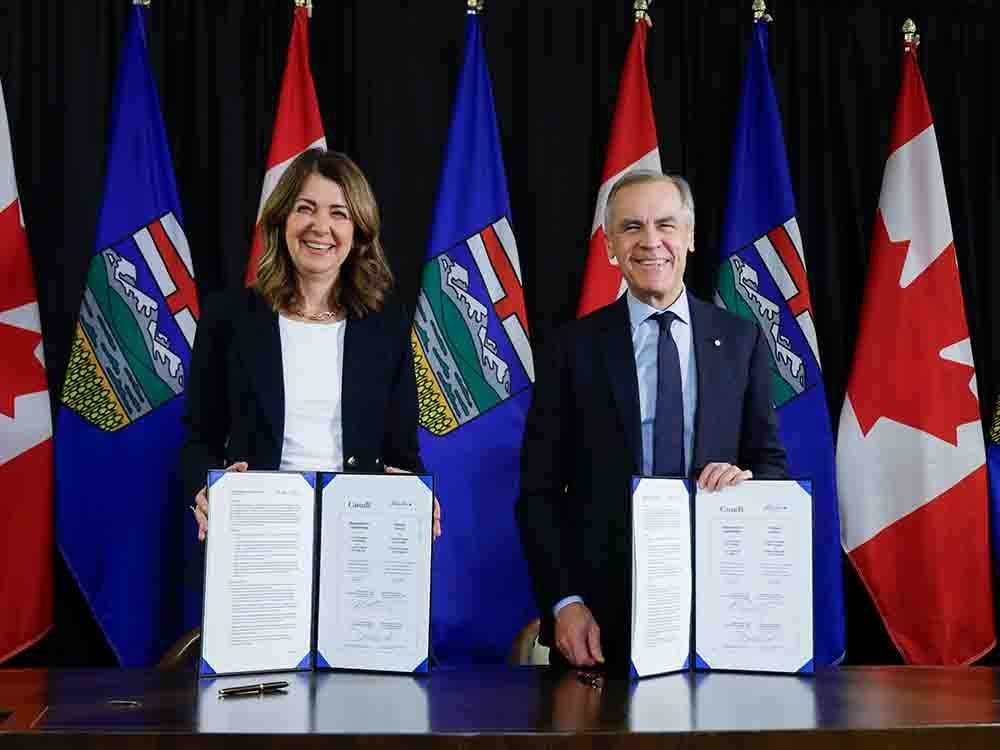
The recent memorandum of understanding between Alberta and Ottawa has been framed largely as a pipeline deal. Listen closely to the language from both sides and a deeper shift becomes clear — a reframing of how Canada competes in a world where industrial capacity, carbon competitiveness and energy security increasingly determine economic strength.
Prime Minister Mark Carney billed it as “a framework for building more competitive, independent, and sustainable economies.” Premier Danielle Smith described it as “Alberta’s moment of opportunity . . . to show the nation as well as the entire world that resource development and emissions reduction can not only coexist but actually complement one another.”
This is the new reality in an era of energy coexistence, where traditional and low-emission systems evolve side by side.
Canada must develop competitive industries that meet global demand while strengthening supply chains, and Alberta’s mix of resources, talent and industrial capacity is uniquely positioned to lead this shift. A new analysis from the Energy Futures Lab reinforces this positioning, Alberta’s Future Competitiveness and the Next Wave of Growth shows where and how the province can shape the emerging global trade order.
Carney framed the MOU as part of a “clean energy plus clean economy strategy.” Alberta has the ability — and now the political imperative — to make that strategy real. Commitments to expand and modernize power grids, streamline permitting and expand Alberta’s carbon-pricing system mirror several report recommendations as pillars of an upcoming “industrial transformation” strategy.
Global investors are assessing jurisdictions based on reliable clean power, emissions performance and regulatory certainty. The premier and prime minister appear to recognize that maintaining a credible carbon-pricing system is no longer a political argument, but a competitiveness requirement.
Alberta’s long-standing industrial strengths remain economic anchors, but they also form the foundation for a new wave of resource-based, low-emissions industries. Capturing these opportunities will require the province, industry, Indigenous partners and the federal government pulling in the same direction.
Clean electricity is fast becoming one of the strongest enablers of investment attraction. Clean energy enablers alone represent a $6.5-billion market opportunity. Alberta has opportunities spanning renewables, nuclear and (with carbon capture integrated) waste-to-energy pathways that support a decarbonized grid, including Varme Energy’s Heartland facility, which will convert landfill waste into clean power while capturing upwards of 200,000 tonnes of CO2 annually.
Alberta is already a global CCS leader, hosting six of the world’s 57 large-scale facilities. By leaning into this expertise, the province could add an estimated $379 million annually to GDP while exporting technology and services into a global CCS market expected to reach US$18 billion.
These are tangible, near-term opportunities rooted in real demand and proven capability, not speculative bets.
Critical minerals represent another major opening. The market for transition minerals is projected to reach $290 billion within five years. Canada has geological abundance, but currently Western Canada lacks the processing, refining and component manufacturing needed to anchor these minerals into supply chains.
With Carney’s recent billion-dollar commitment to expand processing capacity, leveraging Alberta’s industrial-processing expertise can help build the missing middle of Canada’s critical minerals value chain. Through the Western Canadian Critical Materials Alliance, the Energy Futures Lab and its partners have developed a regional strategy to close that gap and, with the right signals, Alberta could anchor a multibillion-dollar refining and materials ecosystem across western and northern Canada.
Energy superpowers aren’t created through isolated projects.
Success will require collaboration and catalytic investment to propel new industries. Alberta has what it takes to evolve from a raw resource provider to drive Canada’s emergence as an energy superpower if it delivers the fundamentals — reliable clean power, efficient permitting, investment-ready hubs, modern trade corridors, credible carbon management and policy tools that de-risk capital.
If Alberta and Ottawa stay aligned on these fundamentals — beyond pipelines — Canada has a rare opportunity to lead in the new global energy economy.
Alison Cretney is the managing director of the Energy Futures Lab, an award-winning non-profit organization focused on Alberta’s role in Canada’s energy transition and clean economy.