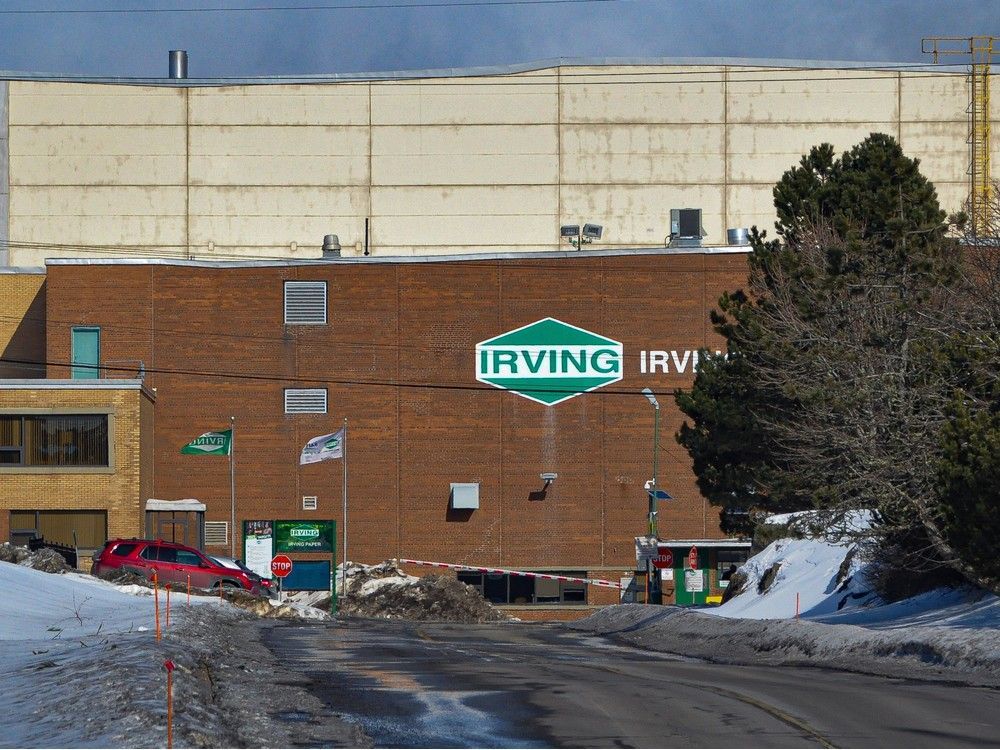
The Holt government is dipping into one of its tariff relief funds to provide Irving Paper Ltd. with up to $45 million it says will maintain jobs at New Brunswick’s only remaining paper mill.
It comes after the Saint John manufacturer of paper used for magazines, catalogues and newsprint announced roughly a year ago it was cutting 140 jobs, while criticizing the impact of “soaring electricity costs” and blaming “management issues” at NB Power.
It also suggested a subsidy wasn’t the answer as all New Brunswickers and the province’s industry were grappling with the challenge of climbing electricity bills.
Meanwhile, it isn’t saying how it will spend millions in government cash.
The money is part of a $54.3-million package for a total of seven New Brunswick companies announced by Opportunities NB.
Last spring, Premier Susan Holt announced a $40-million “competitive growth program” through Opportunities NB that she said would be aimed at stabilizing larger New Brunswick companies that are export-intensive, with the goal to protect jobs, but also fund growth projects.
It was part of the Holt government’s $162-million tariff relief package in attempts to blunt the impact of U.S. President Donald Trump’s sweeping tariffs on Canadian goods.
It was an announcement that came just hours after Trump first slapped tariffs of Canadian exports.
“‘New Brunswick will not be bullied,” a defiant Holt said at the time.
“We are a unique and proud province with the best people and the best products.
“We know our value.”
Now nearly a year later, Opportunities NB says it’s providing up to $54.3 million over the next three years through that fund announced last March.
Luke Randall, minister responsible for Opportunities NB, said that the seven companies receiving funding all applied for the money.
Included is up to $3.8 million in conditionally repayable assistance to support Kelly Cove Salmon Ltd., a division of Cooke Aquaculture, in modernizing its salmon farming operations.
There’s up to $2.4 million in the form of a non-repayable contribution for Agropur Cooperative, a dairy processor, to support modernization of its Miramichi facility and the expansion of milk processing capacity.
Another $2 million over two years is earmarked for Moncton-based cannabis company Organigram toward a capital investment to increase crop yields by 10 per cent.
But the vast majority goes to a single company in Irving Paper.
Opportunities NB states that the $45 million over three years is to support “the global competitiveness of New Brunswick’s only remaining paper mill during a period of significant cost pressure and market volatility.
“This investment is intended to help sustain operations, protecting more than 183 jobs and $20.6 million in annual payroll,” it adds.
It’s a number that was roughly 310 jobs a year ago before layoffs.
Irving Paper declined an interview with its vice president Mark Mosher on Wednesday.
It also hasn’t answered how it will spend the millions in government money or whether any of it will be used to restore lost jobs.
In a public letter last March, Mosher said the company didn’t want a government subsidy to save jobs, but that the province did need to step in to find a solution to high electricity rates.
“I want to be clear that we are not looking for a subsidy,” Mosher said, referencing a call by the local union representing laid-off mill workers for a government industrial strategy that would mean subsidizing electricity for industrial companies.
“After all, the situation facing Irving Paper is not unique.
“We empathize with all New Brunswickers who have recently been facing the challenge of steeply climbing electricity bills. For all of New Brunswick’s energy intensive and trade exposed industries, the issues and repercussions of uncompetitive electricity rates are not new and continue to worsen.”
Mosher noted that while U.S. tariffs are “out of our control,” energy costs don’t have to be.
“Governments and utilities have a role to play,” Mosher said.
The Irving Paper exec did point specifically to its pulp and paper competitors in Ontario, Quebec and British Columbia, stating they all have lower industrial electricity rates, while adding that in Ontario “there are programs in place to provide competitive, stable and predictable rates to industrial consumers.”
Ontario does have a program that supports northern Ontario’s largest industrial electricity consumers that provides a rebate per kilowatt hour used to help maintain their competitiveness and job creation within the region.
It’s unlikely that power rates in New Brunswick will decline.
An ongoing review of NB Power has largely resulted in a call to lower bills.
But NB Power executives, including CEO Lori Clark, maintain that government meddling with rates over the last dozen years or so has meant electricity prices haven’t kept up with inflation. They also point to high debt costs, badly aging infrastructure, and increased demand for electricity as reasons people must pay more for the service they receive.
Randall said Opportunities NB evaluates each request from New Brunswick businesses individually.
“Every one of the companies that we engage with would have had unique pressures,” Randall said. “Some would have been tariff related, and some could have been other competitive factors.
“And what we look at at ONB is ‘will this protect good paying jobs, and will this company be growing good paying jobs in the future?’ And those are two of the tests that ONB and the board look at before saying ‘yes’ to a project.”
Randall stressed that in a number of the projects, including the one involving Irving Paper, the actual dollar commitment might not be paid out.
It’s money contingent on targets.
“They’ll be looking for the company to achieve specific financial results in order to deliver support,” Randall said. “There’s certain conditions that would need to be met in order to deliver financing.
“So even though you’re seeing a $54-million number, that does not mean we’ve paid out $54 million.”
In a statement on Wednesday, the Holt government said that funding to Irving Paper “is performance-based and tied to clear financial and operational conditions.”
That said, it acknowledges that most of the money is to offset a “defined gap between the company’s electricity costs and a competitive benchmark rate.”
Still, there are a few requirements for Irving to receive the $15 million annually in each of the next three years.
“The company must meet defined performance requirements each year to access that year’s funding,” spokesperson Bruce Macfarlane said in a statement.
A central component is “maintaining employment,” seemingly meaning no further layoffs.
The government then states that $15 million of the $45 million must be spent on capital improvements at the mill over the three-year term of the agreement.
Irving Paper must also “maintain appropriate financial capital ratios to ensure the ongoing financial health of the company.”
There’s also a “profitability safeguard,” Macfarlane said.
“If earnings improve beyond established levels in a given year, support for that year is reduced accordingly,” he said. “If profitability reaches a higher agreed threshold, Irving Paper may be required to repay funding received for that year.”
There is also no carrying forward of the money between years, the government notes.
“This structure ensures taxpayer support is limited to what is necessary to maintain competitiveness and protect approximately 183 jobs and $20.6 million in annual payroll,” Macfarlane said.
“If profitability improves beyond agreed thresholds in any given year, assistance for that year is scaled back or repaid, ensuring accountability and responsible use of public funds.”
“The ultimate goal for the Irving Paper file, amongst others, is, ‘are we keeping those good paying jobs? Are we preserving them?’” Randall said.
“It exports $250 million each year. And in February 2025, before it shut down line two, it was supporting 300 suppliers in New Brunswick with 144 purchases from various communities, small and medium sized businesses and other partners.
“So when I was looking at projects coming through the door, we’re looking not at one specific company. We’re looking at the impact of the overall supply chain.”
The minister said that the entire $54.3-million dollar figure comes from within Opportunities New Brunswick’s ordinary budget.
Of note, despite the Holt government as a whole currently on track to post a record high $1.33-billion deficit in the current fiscal year, ONB is actually projected to be under budget by $17 million.
“There are always targets for companies to hit in the contracts they sign with ONB,” Randall said. “So if, for instance, we’re setting aside a payroll program for a company, we’ve set aside the full amount that we would need to deliver to the company if they meet their payroll commitments over a multi year period.
“If the company doesn’t meet their commitments, that would be one reason why we would be under budget, because we won’t be delivering the funding in that case if they didn’t meet their commitment.”
$54.3-million breakdown
- Up to $45 million over three years to Irving Paper Ltd. “intended to help sustain operations, protecting more than 183 jobs and $20.6 million in annual payroll”
- Up to $3.8 million in conditionally repayable financial assistance to support Kelly Cove Salmon Ltd. in “modernizing its salmon farming operations”
- Up to $2.4 million in the form of a non-repayable contribution for Agropur Cooperative, a dairy processor, to support modernization and expansion of its Miramichi facility expected to create more than 10 new jobs
- Up to $2 million over two years to Organigram toward a capital investment to increase crop yields by 10 per cent and enhance efficiency
- Up to $800,000 in the form of a three-year payroll rebate for Stantec to create up to 124 new jobs
- Up to $250,000 for Marwood’s Edmundston facility to “expand operations, improve productivity and strengthen the company’s competitiveness to position it for future growth”
- Up to $115,000 in the form of a payroll rebate for Alliance Seafood Inc., a value-added seafood processor, to support the creation of up to 28 new jobs at its Grand-Bouctouche facility