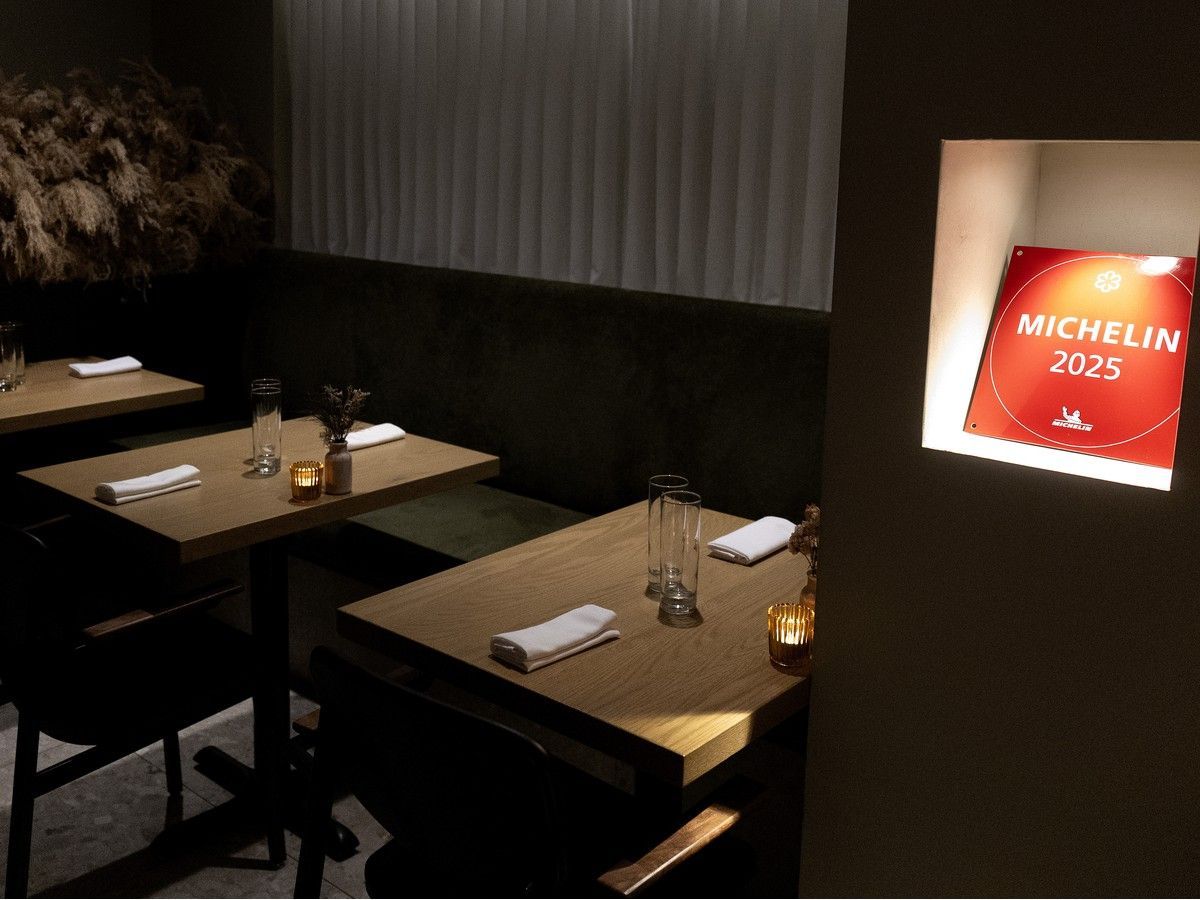
Having a Michelin star hasn’t changed the way Marie-Josée Beaudoin and Patrice Demers run Sabayon, their cosy, terroir-focused eatery in the heart of Pointe-St-Charles, but it has put a spring in their step.
“I was afraid expectations would be very high,” Beaudoin said, “but people are happy for us. There’s a sense of pride. Things are going very well. It has had a very positive effect, aside from the fact we have to say no to a lot of people.”
Sabayon opens bookings one month at a time. Reservations start at noon on the first day of the month prior, through OpenTable. But with just 14 seats in the restaurant, they go quick.
“It used to take two minutes to fill up” for the month, Beaudoin said. “Now, it’s 30 seconds.”
The sommelier handles the front of house while her chef and life partner Demers works his magic in the kitchen.
Sabayon was one of just three Montreal restaurants to receive a one-star rating
— denoting “high-quality cooking” — in
the world-famous fine-dining guide’s inaugural Quebec edition
, published in May of last year. Michelin also served up 44 Recommended, or “Guide-approved” ratings to local establishments and seven Bib Gourmands, for “good quality, good value.”
Quebec City’s Tanière
3
earned the only two-star rating (“excellent cuisine worth a detour”) in the province. Of the eight one-star ratings attributed Quebec-wide, four went to eateries based in the capital (Légende, ARVI, Kebec Club Privé, Laurie Raphaël) and one went to Narval in Rimouski.
Beaudoin and other Montreal restaurateurs were appreciative as they reflected on the honours they received, as the clock ticks down to Michelin’s impending return to update its list at the one-year mark in May.
Its anonymous inspectors are surely doing their final rounds of the province’s eating establishments
. (Quebec has a renewable, three-year contract with the Michelin Guide.)
“It’s been a bit crazy,” Beaudoin admitted, of the Michelin effect. “We really see the interest from abroad. Before, we attracted people from greater Montreal and the regions. Since Michelin, we get people from Vancouver, the U.S. and Europe. Last summer, a lot of Europeans were calling to make reservations.

“It’s a nice clientele. People are very interested in what we’re doing. They spend a bit more. We have a set-price tasting menu, but in terms of alcohol, they might buy champagne by the glass. For many Quebecers, it was their first time eating at a Michelin-starred restaurant. So there was an excitement. Some people were like, ‘Oh my god, we’re eating at a Michelin restaurant.’”
Trained in professional cooking before turning to pastry, Demers opened the pastry and wine shop Patrice Pâtissier with Beaudoin in 2014, earning him Pastry Chef of the Year at Quebec’s first Lauriers awards in 2018. They closed in 2022 and opened Sabayon a year later.
They have made only one change since receiving their Michelin star, increasing the hours of their lone employee to help Demers in the kitchen. “It allows me to concentrate on our customers and serve everyone,” Beaudoin said.
Aside from that, and a modest price bump to keep up with inflation, she and Demers have kept it business as usual. They haven’t increased their capacity or their limited opening hours. Currently, Sabayon is open just three days a week, Thursday to Saturday. And that suits the couple just fine. Now in their mid-40s and having paid their dues, they have made Sabayon a labour of love — which is part of the restaurant’s magic formula.

There’s a similar serenity over at Mastard in Rosemont, opened in 2021 by chef Simon Mathys and partner Viki Brisson-Sylvestre. The two are “still on a cloud” about their Michelin star.
“It stabilizes the reservations,” Mathys noted. “It has brought only good things. It’s a pat on the back for our team — the nicest recognition you can get. But it doesn’t really change anything. Essentially, everything is the same. We’re working the way we have since we opened (in 2021), pushing ourselves further and always wanting to improve.”
Mastard has a five-course tasting menu highlighting local ingredients “with a modern touch.” The restaurant has one daily seating, serving between 55 and 60 customers per night, Monday to Friday.
“We don’t surpass that, in order to ensure quality,” Mathys said. “We do the work and take time with our clients. We didn’t try to double our capacity (because of our Michelin star), though we could have. We decided to continue doing what we were doing, same as before.”
It’s about work-life balance, Mathys explained. The weekends off afford him and Brisson-Sylvestre precious family time that is too often sacrificed to the demands of the restaurant industry.

Work-life balance is the reason cited by chef and co-owner Jérôme Ferrer as he prepares to close Jérôme Ferrer – Europea, the only other Montreal restaurant to receive a Michelin star. Heart problems no longer allow him to maintain the frenetic pace the job requires, and so he has put his
establishment up for sale for $1.985 million
.
It’s a surprising turn for a star chef who less than a year ago was living the dream. A Gazette photographer was on hand when a tearful Ferrer called his mother last May to share the news of his Michelin star.
“It’s the fruit of 23 years of work,” he told this reporter at the time. “We’re very, very happy. For us, it’s excellence. Michelin stars are a reference worldwide. It’s a recognition of who we are.”
Ferrer credited his team, saying “the real success belongs to the people around me” and noting that “40 per cent of the people working at the restaurant have been with me since the beginning.”
The tone shifted two months later with the publication of a La Presse investigation that cited 23 former employees complaining of verbal and physical abuse and sexism while working under Ferrer, who denied any wrongdoing.
“I refute,” he told La Presse, in response to the allegations. “No, I would condemn such behaviour. It’s false. It’s a lie.”
Ferrer did not respond to multiple interview requests from The Gazette for this article.

Quebec is the third Canadian destination showcased by the Michelin Guide in recent years, after Toronto and Vancouver’s inductions in the fall of 2022.
Tourism associations including the Alliance de l’industrie touristique du Québec and Tourisme Montréal contributed an “estimated $1 million” — according to one inside source choosing to remain anonymous — to help bring the Michelin judging team around the province.
A total of 102 restaurants made it into the guide’s inaugural Quebec edition in 2025. Michelin’s choices elicited mixed reactions in Montreal. Many of our city’s most notable restaurants did not get stars, instead ending up with “Michelin Recommended” ratings while others were omitted altogether.
“It’s disappointing for my team,” famed Toqué! chef Normand Laprise said last year of the recommendation his restaurant received in lieu of a star. “Toqué! has existed for 32 (now 33) years but OK — Michelin makes their own breakdown. It’s what they decided. … It’s a bit odd but it’s a rating like the others. If it’s not this year, maybe it will be next.”
The scales may get balanced when the guide returns in May. Michelin has been known to tread carefully on arrival, then expand its rankings on subsequent visits. Two Toronto restaurants joined the star-studded for the city’s second Michelin Guide in 2023, one of which had received a recommended rating the year prior, while seven restaurants were added to the recommended list and four to the Bib Gourmands.
Four more restaurants received stars as Michelin branched out to surrounding areas for its Toronto and Region edition in 2024. And a dramatic twist occurred in 2025 as reigning champion Sushi Masaki Saito had one of its two stars removed, reducing it to a one-star ranking while another restaurant, Pearl Morissette, was promoted from one to two stars and earned a Michelin Green Star, for sustainable practices.
But while the pressure may be on for Quebec restaurateurs, those contacted by The Gazette said they would keep doing what they were doing, either way.
“Whatever mention we have, whether it’s starred or Bib Gourmand, we take it one year at a time,” Sabayon’s Beaudoin said. “For sure, it would be a big shame to lose a star after a year — we hope to keep it. But it’s less stressful for us at this point in our career.”
If anything, Beaudoin says she’s crossing her fingers that Sabayon will have some company in May:
“We’re really hoping there will be more stars in Montreal at the next announcement.”

“We haven’t changed a single thing” in anticipation of Michelin’s return, said Mon Lapin co-owner Vanya Filipovic. She and chef-partner Marc-Olivier Frappier’s acclaimed restaurant and wine bar was one of several top Montreal eateries to receive a Michelin Recommended rating last year. And while she was fine with that, she was unsure how to quantify its effect.
“It’s hard to say. We’re not a new restaurant,” Filipovic said. “We’ve been open eight years now and received a couple of accolades that have helped us get noticed, on lists and in articles.”
She was being modest. Mon Lapin topped Canada’s 100 Best Restaurants in 2023 and 2024,
, leaving many shocked it didn’t receive a Michelin star. Filipovic was not among them.
“One is a list with a panel of diners, let’s call them, who assess their favourite places in a year,” she said. “The other is decided by Michelin judges according to strict criteria. We were not in any way, shape or form expecting a star. Our place is very casual, dimly lit, with loud music and a hustle-bustle, jam-packed bistro vibe. But our clients were disappointed we didn’t get a star, and they mention it.”
Truth be told, Filipovic and Frappier were showered with praise from Michelin. She received the guide’s Sommelier Award, which surprised her “because I’ve been around a while. I’m no longer the fresh new discovery nobody knows. That was really unexpected. I’m very grateful.”
And
the couple’s new Rôtisserie La Lune
, just down the street, earned a Bib Gourmand.
“Honestly, that’s everything we could hope for,” she said of La Lune. “It really is the essence of the place. The idea was to create a neighbourhood spot, and a very accessible one. We were thrilled with the mention. It captured what we’re trying to do.”
Their customers are excited too.
“Probably because we were a new restaurant when we got the Bib — we had been open five months — people tend to notice and mention it more,” Filipovic said. “Perhaps because it’s their first time at the Rôtisserie when they come.
“With Mon Lapin, maybe they’ve been once or twice, so it’s not as important what recent accolades have come in. But at La Lune, people congratulate us. A lot of people say, ‘It’s our first time trying a Bib Gourmand restaurant.’”

An unexpected bonus of the Michelin’s arrival in Quebec is its power to shine an international spotlight on restaurants that one might not expect. While the guide is still associated with traditionalist notions of upscale French cuisine, it has been making an effort in recent years to expand its palate.
Getting a Michelin Recommended designation brought a prestigious nod of credibility to Afro-Portuguese restaurant Le Virunga, run by Zoya de Frias and her chef-mother, Maria-José de Frias.
“When you’re talking African gastronomy, there’s a connotation of the familiar,” Zoya de Frias said, “of traditional, shared dishes and a homemade style, artisanal but not structured and not fine-dining. I think for clients who discover us through the Michelin Guide, it gives us a stamp of approval and makes them want to try a type of cuisine they weren’t familiar with.”
Even for customers who don’t discover their intimate Plateau restaurant through Michelin are impressed when they learn it is recognized by the guide.
“Sometimes it’s a bonus,” de Frias said. “Clients find us because they’re looking for something different, and when they get here they say, ‘Oh, we didn’t know you’re in the Michelin Guide.’ It adds a titre de noblesse. It reassures them they’re at the right place, they chose well. They’re more ready to get into the experience.”
Her mother is originally from the Democratic Republic of Congo. De Frias grew up in Belgium, arriving in Quebec at age 16; she earned a double degree in mathematics and statistics and computer science from Concordia University before joining her mother — who studied culinary arts at LaSalle College — in the restaurant venture in 2016.
She describes Le Virunga’s concept as “pan-African and sub-Saharan cuisine with products from the terroir.” Inspired by the foods of several African countries, the menu is “a way to assemble our cultures in a spirit of discovery for people of the diaspora and clients not familiar with this cuisine. It’s a bridge between cultures: local Quebec products and African gastronomy.”
Being recommended by Michelin was an emotional experience for both women.
“We felt butterflies,” de Frias said. “My mother was very touched when I told her. We’re proud to represent our community. We were the only African restaurant to be recognized. There’s no other one in Canada in this category.”

A short walk west along Rachel St. from Le Virunga is another Montreal restaurant one might not have looked for in the Michelin Guide, Kevin Fung’s popular Plateau ramen joint Yokato Yokabai.
The recognition has brought new clients and added pressure, according to Jung Kim, district manager for all of Fung’s Japanese restaurants, including the adjoining tapas spot Ichigo Ichie Izakaya.
“We’ve had a lot more clients — and more expectations,” Kim said. “We get many people who are curious what ramen is. Our mentality is to create an experience of Japan in Montreal. We make ramen that is authentic and homemade. We put a lot of effort into preparation and ingredients. Being recommended by Michelin is recognition of all our work over the years.”
But many customers don’t know the difference between a Michelin Recommended rating and a Michelin star, according to Kim.
“It’s a double-edged sword,” he said. “So not only do we have to maintain quality but we have to improve quality because expectations are higher.”
Fung branched out in 2023,
adding Lester’s Deli in Outremont to his modest empire
.
“He has no connection to (Jewish) culture,” Kim said, “but his mentality is he wants to open authentic restaurants with quality food.”

Not far from Yokato Yokabai is Montreal institution L’Express, which was closed for renovations when it received a Bib Gourmand from Michelin last year. Yet business picked up where it left off when the legendary St-Denis St. bistro reopened in the fall.
“Most of the work was structural — plumbing, electricity and to the façade — things our clients won’t see,” said co-owner and director of operations Marc-Olivier Gavina. “There was no visual impact, it was operational.”
Gavina hasn’t noticed a surge in business because of the Michelin nod. The 70-seat eatery is steadily packed, as ever, so it can be hard to tell.
“People mention it a bit,” he said. “We have the plaque out front. But at the same time, for our regular clients, they congratulate us but it doesn’t change much.”
Opened in 1980 as a classic French brasserie that would be home to the actors and aficionados of Montreal’s vibrant cultural scene before, after or as the main event of a night on the town, L’Express is open 7 days a week from 11:30 a.m. to 1 a.m.
The Bib Gourmand is “what represents us best,” Gavina opined. “We’re not a white-tablecloth restaurant with a tasting menu. The Bib, when you read the definition, it fits. It’s a place where you eat well for a reasonable price, with a nice atmosphere and good service.”
And while he and the rest of the team at L’Express don’t aspire to more, they won’t turn up their nose at the accolade.
“Everyone is definitely happy to have the recognition,” Gavina said. “Michelin is quand même a world reference.”