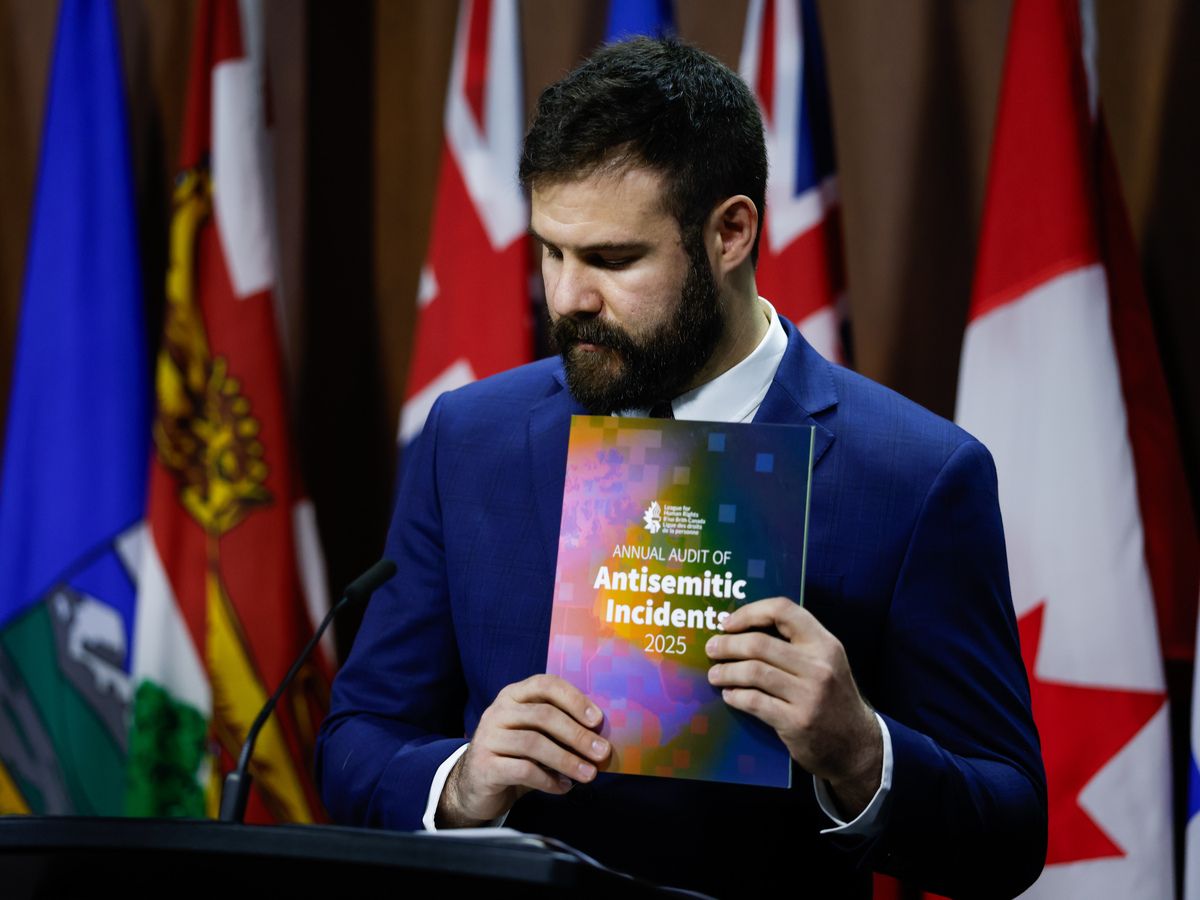
The latest annual audit of antisemitic incidents in Canada shows an increase of almost 10 per cent since last year, driven by a spike in online harassments even as incidents of violence and harassment fell slightly.
B’nai Brith Canada’s
released its annual audit on Monday, documenting 6,800 incidents of antisemitism across the country, equivalent to an average of 18.6 incidents per day. This is the highest volume recorded since the audit began in 1982.
The increase has been even more dramatic when compared to 2022, prior to the Hamas terror attacks of Oct. 7, 2023, in Israel. While antisemitic incidents rose by 9.3 per cent in Canada last year, they were up 145.6 per cent between 2022 and 2025.
Join B’nai Brith Canada this morning, Monday, April 27 at 9:00 AM EDT, for the launch of the Annual Audit of Antisemitic Incidents 2025.
Hear from our speakers as they break down the latest data and what it reveals about antisemitism in Canada today.
Click the link below to… pic.twitter.com/Ww5QDv4U3w
— B’nai Brith Canada (@bnaibrithcanada) April 27, 2026
The report said the increase this year could be linked in part to the war on Iran, but also noted that antisemitism has become so widespread that the conflict cannot be considered its primary source.
“Antisemitic conspiracy theories were disseminated with such frequency in 2025 that it is easier to summarize the totality of the accusations made against Jewish Canadians by simply stating that they were made the scapegoats for all the world’s problems,” said Richard Robertson, B’nai Brith Canada’s Director of Research and Advocacy, at a press conference in Ottawa at which the report was released.
He added: “Antisemitism has become so ubiquitous in our society that the word Jew is now commonly used as a slur to disparage and malign non-Jews. In contemporary Canada, Jewishness itself has become derogatory.”
Ontario, the Prairies, Atlantic Canada and British Colombia experienced significant increases in the number of documented incidents in 2025, while in Quebec and Alberta, the total number declined.
The report also noted that most incidents (92 per cent) occurred online, part of a continuing trend. In the previous two years, about 85 per cent of incidents were online, while from 2019 to 2022 it was closer to 74 per cent.
Robertson said governmental response was important, regardless of the origins of the incidents.
“We need to protect Canadians from the dangers that are rapidly increasing and emerging from digital spaces,” he said. “Whether they are being fuelled by foreign-based entities or by foreign corporations, that shouldn’t matter. Canada must regulate its online realm and must protect Canadians from the dangers presently existing within it.’
In addition to calling for a federal Royal Commission on antisemitism, the report listed recommendations for each level of government.
At the federal level, it said the government needs to establish a national antisemitism emergency task force, treat violent antisemitic attacks as domestic terrorism, and deploy additional national security resources to protect Jewish institutions.
For the provinces and territories, it recommended funding immediate security protection for Jewish institutions and establishing a special prosecution unit for hate crimes. And at the municipal level, it called for a ban on events that incite hate and intimidation, zero tolerance for intimidation in public spaces, and the prioritization of protection for Jewish neighbourhoods and institutions.
“What we need in Canada is a multi-level approach to fighting antisemitism,” Robertson said. “This is a national crisis. We need task forces. We need consolidated efforts to provide … the immediate relief that is required, such as security infrastructure, funding and policing. But we also need legislative change. And this is something that no government in this country can do alone.”
The report has a section on what it calls “the demonization of Zionism,” something Robertson addressed.
“There is nothing wrong with criticizing a foreign government,” he said. “There is nothing wrong with disagreeing with the actions of a foreign government. But that’s not what’s recorded in our audit. What’s recorded in our audit is political discourse that has crossed the line into hate.”
He added: “It is not OK to subject a minority in this country to unprecedented levels of hate because of the actions of a foreign government.”
Robertson also commented on Al-Quds Day, an annual event that led to protests in Toronto and elsewhere last month. The report calls this “the most immediate test” for municipal governments to ban “rallies that glorify violence, celebrate terrorist organizations, or call for the destruction of Israel.”
This year, Ontario Premier Doug Ford sought an emergency injunction to stop the Toronto rally, but an Ontario judge dismissed the attempt, and the march went ahead.
“Al-Quds Day is an event directly linked to the Iranian regime and to the IRGC (Islamic Revolutionary Guard Corps), a listed terrorist entity in this country,” Robertson said. “It is unacceptable, quite frankly, that events directly associated with terror are allowed to occur on an annual basis in this country. That must end immediately.”
He also noted that, while various levels of government had made inroads, “the numbers speak for themselves. This is a national crisis, and we have not seen a response sufficient to the moment. We need a whole-of-government approach. We need the same response to tackling antisemitism that we’ve seen from our federal government when it comes to other crises in this country.”
Our website is the place for the latest breaking news, exclusive scoops, longreads and provocative commentary. Please bookmark nationalpost.com and sign up for our daily newsletter, Posted, here.