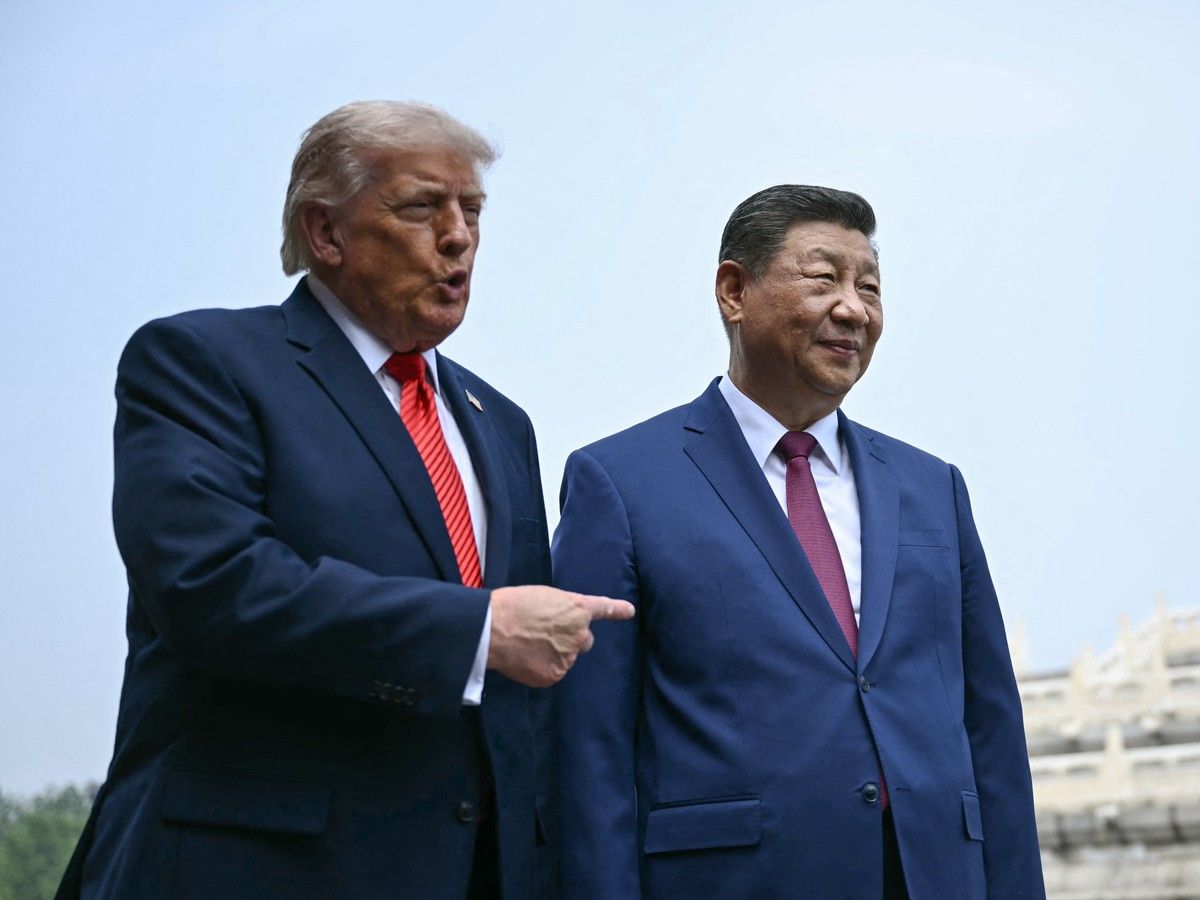
U.S. President Donald Trump began his much-vaunted official state visit to China this week for talks with his Chinese counterpart, Xi Jinping.
The visit is the first by an American president since Trump himself visited during his first term in 2017 and the intention is to ease trade issues between the global superpowers.
The visit has been closely watched by Chinese and U.S. media since it began on Wednesday night.
So far, the visit has included a ceremonious welcome, bilateral talks, a visit to the Temple of Heaven UNESCO site, and a lavish banquet. There are more talks on Friday, followed by a tea reception before Trump and company return to the U.S.
Here are some moments you might have missed.
Trump-Xi handshake awkwardness — no ‘big, fat, hug’ for the U.S. president
Ever since his first term in office, Trump, when first greeting world leaders and heads of state and government, has a documented history of an aggressive handshake that starts with him pulling the other person’s arm toward him.
Canadians will remember many when he tried it with former Prime Minister Justin Trudeau, who held firm against the shake and yank.
It appears Trump employed the tactic when he greeted Xi on the steps of the Great Hall of the People on Thursday morning.
In clips shared on X, the sound of music crescendos and stops as the leaders grasp hands and engage in a small tug-of-war. They exchange a few indiscernible words and continue holding hands for 13 seconds, with Trump patting the back of Xi’s held hand twice, before turning to pose for photos.
Before the visit, Trump said on social media that he expected “a big, fat, hug” from Xi, per The Associated Press.
🤝 Xi Jinping didn’t let Trump win the battle for handshake dominance
So… a draw? https://t.co/LHgEXIMoAU pic.twitter.com/GzsfufJ8S7
— NEXTA (@nexta_tv) May 14, 2026
Trump arrives, Xi noticeably absent at the airport
When Air Force One land at Beijing Capital International Airport around 8 p.m., Xi wasn’t standing on the red carpet to welcome Trump and his entourage — family members, several members of his administration and 17 tech CEOs, including Tesla and SpaceX’s Elon Musk and Nvidia’s Jensen Huang.
Instead, it was Vice-President Han Zheng and other officials. Zheng, the eighth-ranked member of China’s government, attended Trump’s inauguration last year on behalf of Xi, as reported by CNN .
Flanking him were a military honour guard and a few hundred adolescents waving American and Chinese flags and chanting “Welcome, welcome, a warm welcome” in Chinese over the music.
While many pro-Trump voices online were quick to label it a sign of disrespect, it was consistent with protocol that China’s head of state does not welcome visiting foreign heads of state. Xi also wasn’t there to greet Trump on touchdown in 2017, nor has he greeted allies such as Russia’s Vladimir Putin or North Korea’s Kim Jong Un on arrival in China.
Experts cited by the New York Times reported that said Zheng was a slight downgrade from 2017, when he was welcomed by Yang Jiechi, a top diplomat and high-ranking member of the highest executive and policy-making body within the country’s ruling Communist Party.
“It’s an example of how, throughout this summit, China is hoping to trade symbolism for substance — using protocol and Trump’s preference for pageantry to hold off a return to economic escalation and buy time for China,” said Julian Gewirtz, a China historian at Columbia University.
NOW – Trump arrives in Beijing with Elon Musk and Jensen Huang in tow. pic.twitter.com/Vfk0Mdfo5D
— Disclose.tv (@disclosetv) May 13, 2026
Xi turns to Ancient Greece, references Thucydides trap
As reported by AFP , it’s not uncommon for Xi to reference ancient Chinese classical maxims or poems in his speeches. But on Thursday, he turned to ancient Greece.
“Whether China and the United States can transcend the so-called Thucydides Trap and forge a new paradigm for engagement between major powers, whether we can work together to address global challenges and bring greater stability to the world, whether we can jointly create a brighter future for bilateral relations — these are questions of history, questions of the world, and questions of the people,” he said, per ABC .
Based on the Athenian historian’s observations of the Peloponnesian War, the term was coined and popularized by Harvard political scientist Graham Allison for this theory on how rising tensions between two powers — one ruling, the other rising — will eventually lead to war.
Trump calls Xi’s a great leader: ‘Sometimes people don’t like me saying it’
Trump has often been critical of China during his political career and existing trade tensions between the nations were further complicated by Trump’s sweeping tariffs.
Last February, he wrote on Truth Social that anyone opposed to his use of tariffs must be “controlled by China.”
Last fall, he imposed an additional 100 per cent tariff on Chinese imports in retaliation for the country’s new rare earth export controls. A deal was later worked out for lower rates.
When Prime Minister Mark Carney travelled to Beijing in January, where he struck a new trade deal with Xi, Trump said on Truth Social that “China will eat Canada alive, completely devour it” and threatened a further 100 per cent retaliatory tariff on Canada.
And while Trump has generally been flattering of Xi in social media posts, venerating his intelligence and leadership, he’s also criticized him at times.
When Xi welcomed Putin and Kim to Beijing for a military parade last year, Trump offered his “warmest regards” to the leaders as they “conspire against The United States of America.”
( @realDonaldTrump – Truth Social Post )
( Donald J. Trump – Sep 02, 2025, 9:15 PM ET )The big question to be answered is whether or not President Xi of China will mention the massive amount of support and “blood” that The United States of America gave to China in order to… pic.twitter.com/RzPHYH8IJt
— Fan Donald J. Trump 🇺🇸 TRUTH POSTS (@TruthTrumpPosts) September 3, 2025
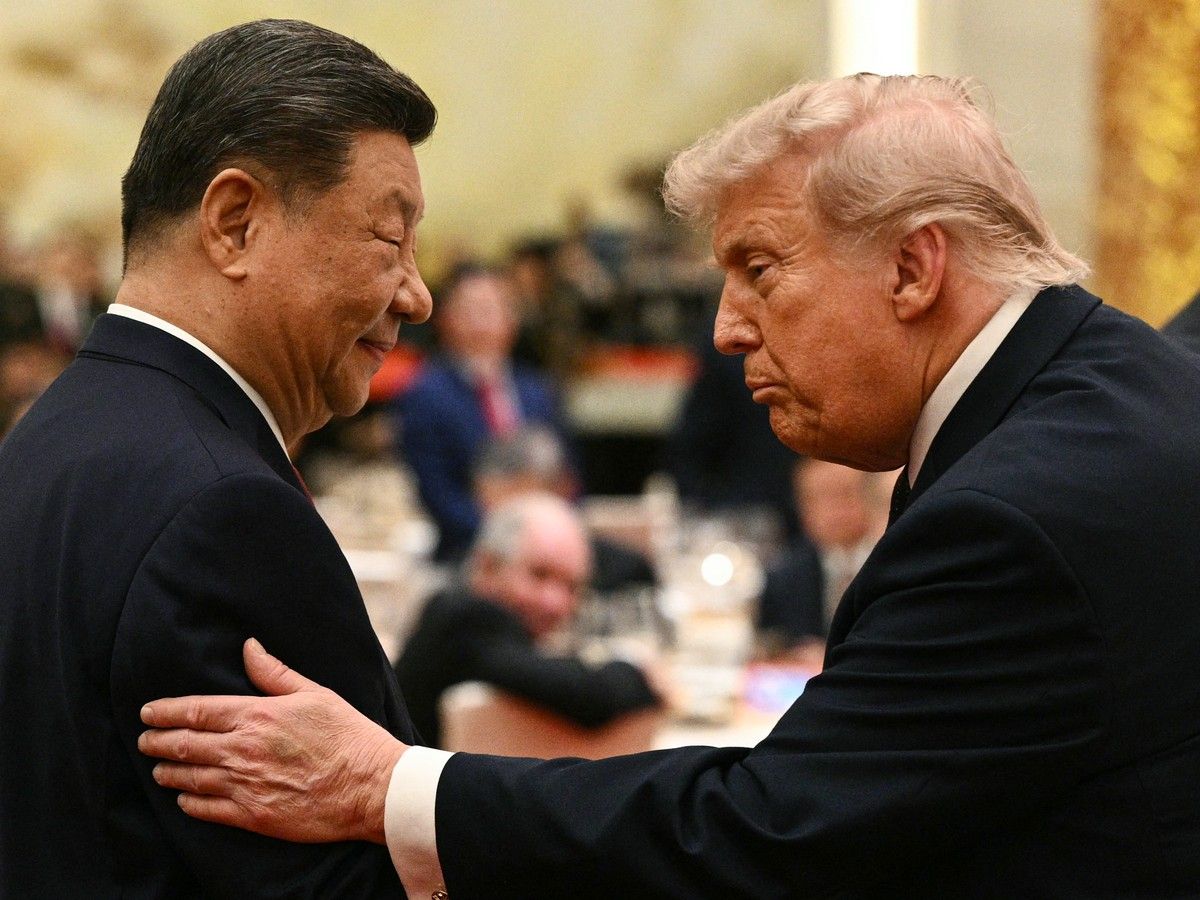
Thursday in Beijing, he struck a more cordial tone and lauded Xi.
“You’re a great leader,” he said during bilateral talks on Thursday, according to The Guardian . “Sometimes people don’t like me saying it, but I say it anyway, because it’s true. I only say the truth … It’s an honour to be your friend.”
In his address, Xi said China and the U.S. “should be partners, not rivals,” but never mentioned a friendship specifically, NBC reported.
Trump’s visit falls on ‘crazy Thursday’
Social media users in China made the most of Trump’s visit by sharing AI-generated memes.
One popular joke was that the president scheduled his visit to align with “Crazy Thursday” in China, a weekly price discount promotional event by KFC China. One AI image shows Trump serving behind the counter while another features him, Musk, Apple CEO Tim Cook and Huang eating at KFC.
Another AI-generated video depicts Xi, Trump, Musk and Cook drinking beer, smoking cigarettes and eating food at what Trump describes as the “best night market.”
今晚Trump和Xi会面之后的after party be like pic.twitter.com/sJ09CDymUW
— 加密小象 (@cryptoxiaoxiang) May 12, 2026
Tense hot mic moment
While not directly involving Trump or Xi, a tense moment between security and journalists was caught by a camera’s hot microphone, multiple outlets are reporting, including AFP.
In a clip being shared widely on X, there seems to be some jostling for position as Trump and White House Press Secretary Karoline Leavitt are briefly seen walking away.
As the camera moves around, at one point a man not shown is heard saying “no, no” to which another responds, “Get the f— out of the way.”
Trump-Xi talks ‘get the f*ck out’ show mad man yell ‘MOVE’ — new angle https://t.co/Lyn4AbIdlE pic.twitter.com/qbCE4yhpsb
— RT (@RT_com) May 14, 2026
Our website is the place for the latest breaking news, exclusive scoops, longreads and provocative commentary. Please bookmark nationalpost.com and sign up for our daily newsletter, Posted, here.