A surprise economic slump to start the year prompted forecasters to slash their expectations for Canada’s growth for 2026.
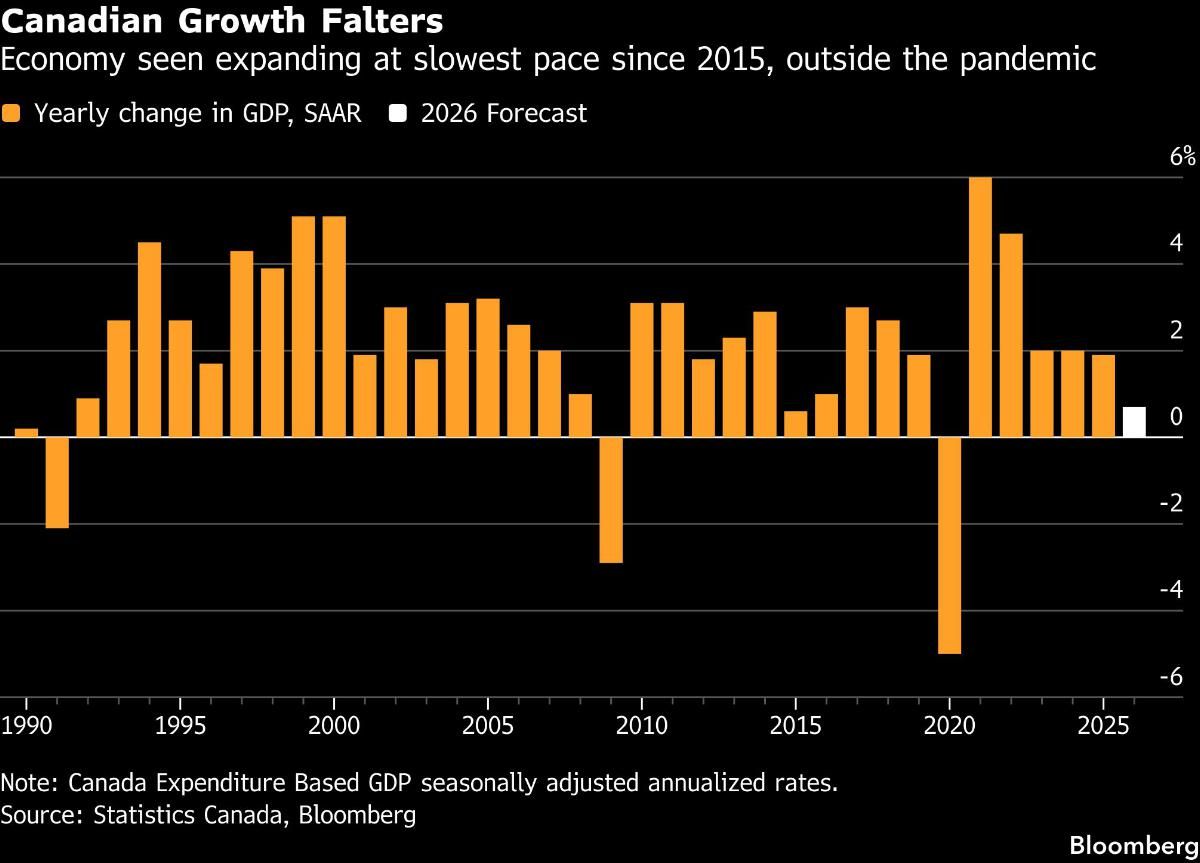
Economists in a Bloomberg survey now see Canada’s economy expanding just 0.7 per cent this year after shrinking in the first quarter. If it comes to pass, it would be the weakest yearly pace of growth since 2015, outside the COVID-19 pandemic.
It’s a big step down from previous forecasts of 1.2 per cent growth , and would bring the country’s expansion more closely in line with its peers in the Group of Seven. Previously, Canada’s growth outlook was seen as lagging only the United States among those countries.
The economy shrank 0.1 per cent on an annualized basis in the first three months of 2026, significantly missing analysts’ forecasts for a 1.5 per cent expansion. That was partly driven by an unexpected drop in federal defence spending, and though small, it marked a second consecutive quarterly contraction, satisfying one condition of a recession .
Most economists and the central bank have rejected the recession label for the downturn, but mounting damage from U.S. trade policy and an abrupt slowdown in immigration of non-permanent residents have led to weaker growth.
At the same time, the sluggish start to the year led analysts to revise their forecasts higher for the second quarter. They now see the economy expanding at a 1.9 per cent pace, up from 1.4 per cent, from April through June.
There’s evidence that the lingering uncertainty about the fate of the trade agreement between Canada, the U.S. and Mexico continues to sap business optimism. Economists cut their outlook for gross fixed capital investment, which they see expanding at a 0.4 per cent clip this year, down from a previously expected 0.8 per cent gain.
Inflation forecasts were little changed — analysts see the consumer price index rising at an average pace of 2.6 per cent in 2026 before decelerating to the Bank of Canada’s two per cent target next year. The unemployment rate is expected to peak at 6.7 per cent in the second and third quarters of this year, falling to six per cent by the end of 2027.
Forecasters see the Bank of Canada holding its policy rate at the current 2.25 per cent for the rest of 2026, before hiking rates in the second quarter of 2027.
The survey of 28 economists was conducted between June 19 and 24.
—With assistance from Mario Baker Ramirez.