
Oil’s wild price swings this summer have been playing havoc with central bank expectations.
Crude prices soared to more than US$100 last week after the conflict between the United States and Iran flared up again — and with them rose market bets on interest rate hikes.
A full hike was added to the outlook for the Bank of England and European Central Bank when the 30 per cent jump in oil prices over July raised the spectre of higher inflation, said National Bank of Canada strategists in a recent note.
Odds of the U.S. Federal Reserve increasing its rate Wednesday crept up to 40 per cent at one point from as low as 10 per cent as price pressures mounted.
Oil prices have fallen back this week during a pause in hostilities with Brent crude oil easing to below US$86 today. But interest-rate swaps are still implying about a one-in-three chance of a quarter-point increase by the Fed tomorrow, reports Bloomberg — “an unusually high degree of uncertainty so close to a Fed decision.”
The Bank of Canada , on the other hand, has remained largely untouched by this frenzy, with expectations of its policy rate in December rising just five basis points.
“The relationship between oil prices and BoC policy expectations has weakened of late, while remaining strong elsewhere,” said the strategists.

Energy prices do matter to Canada, they said. It’s just that at the moment they are being overshadowed by developments at home.
A “somewhat dovish” central bank decision this month, cooler inflation data and Donald Trump’s renewed tariff threats to Canada’s economy have kept expectations of a rate increase in the near term in check, they said.
They haven’t been removed altogether, however — just pushed into next year.
“Indeed, if market pricing proves accurate, the BoC could deliver more tightening than any other central bank in our advanced economy sample next year,” said the strategists Friday.
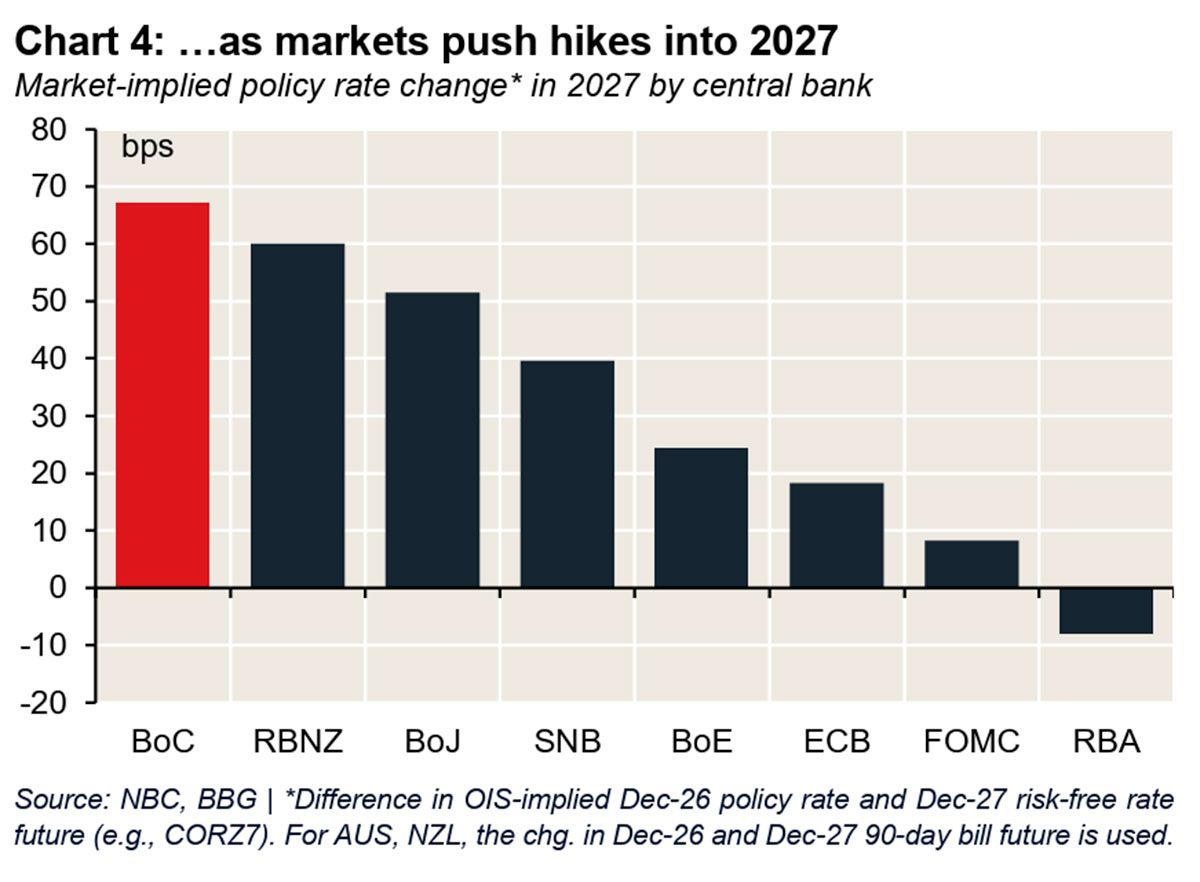
National Bank is not convinced that the Bank of Canada will need to take its interest rate to the high end of the neutral range of 2.25 per cent to 3.25 per cent in 2027, as markets imply.
It thinks the bank will begin tightening in the first quarter, raising rates to 2.75 per cent by the end of the year. That’s later than the path the markets are predicting, but earlier than the median private sector consensus that doesn’t expect hikes until the third quarter of 2027.
A survey of Canada’s big six banks reveals a wide spread of expectations. CIBC, like National, is forecasting the Bank of Canada raises its rate to 2.75 per cent by the end of 2027, but Royal Bank of Canada predicts the rate will hit 3.25 per cent.
Bank of Nova Scotia puts the policy rate finishing 2027 at 3 per cent, while Toronto Dominion and the Bank of Montreal see it unchanged at 2.25 per cent for all of next year.
Sign up here to get Posthaste delivered straight to your inbox.


Alberta’s proposed West Coast oil pipeline could expand Canada’s export capacity by close to 20 per cent, and more than double the volume of crude able to reach tidewater for overseas shipment, say economists with Toronto Dominion Bank.
The pipeline, which is estimated to cost $35 to $44 billion, would have a capacity of roughly 1 million barrels a day. To put that in context, the Trans Mountain Expansion added about 590,000 bpd of capacity when it entered service in 2024, the economists said.
The province has applied for its proposal to be designated as a project of national interest and a decision could come as early as Oct. 1.

- Today’s Data: United States Conference Board consumer confidence
- Earnings: Great-West Lifeco Inc., Ford Motor Co., Coca-Cola Co., Boeing Co., Visa Inc., Intact Financial Group



- About $500 billion in natural gas lies off Newfoundland’s coast. Can Canada tap it?
- Bank of Canada survey tags Trump’s trade tensions as top risk to economy
- The market’s biggest risk isn’t AI or tariffs. It’s something stock investors may overlook

Investors have had plenty to worry about lately with the re-escalation in tariffs, the uncertainty surrounding AI capital spending and the upcoming wave of earnings releases. But Financial Post investing columnist Martin Pelletier says there is a bigger risk out there that they may be overlooking. Find out more
 Interested in energy? The subscriber-only FP West: Energy Insider newsletter brings you exclusive reporting and in-depth analysis on one of the country’s most important sectors. Sign up here.
McLister on mortgages
Want to learn more about mortgages? Mortgage strategist Robert McLister’s Financial Post column can help navigate the complex sector, from the latest trends to financing opportunities you won’t want to miss. Plus check his mortgage rate page for Canada’s lowest national mortgage rates, updated daily.
Financial Post on YouTube
Visit the Financial Post’s YouTube channel for interviews with Canada’s leading experts in business, economics, housing, the energy sector and more.
Today’s Posthaste was written by Pamela Heaven with additional reporting from Financial Post staff and Bloomberg.
Have a story idea, pitch, embargoed report, or a suggestion for this newsletter? Email us at posthaste@postmedia.com .
Bookmark our website and support our journalism: Don’t miss the business news you need to know — add financialpost.com to your bookmarks and sign up for our newsletters here