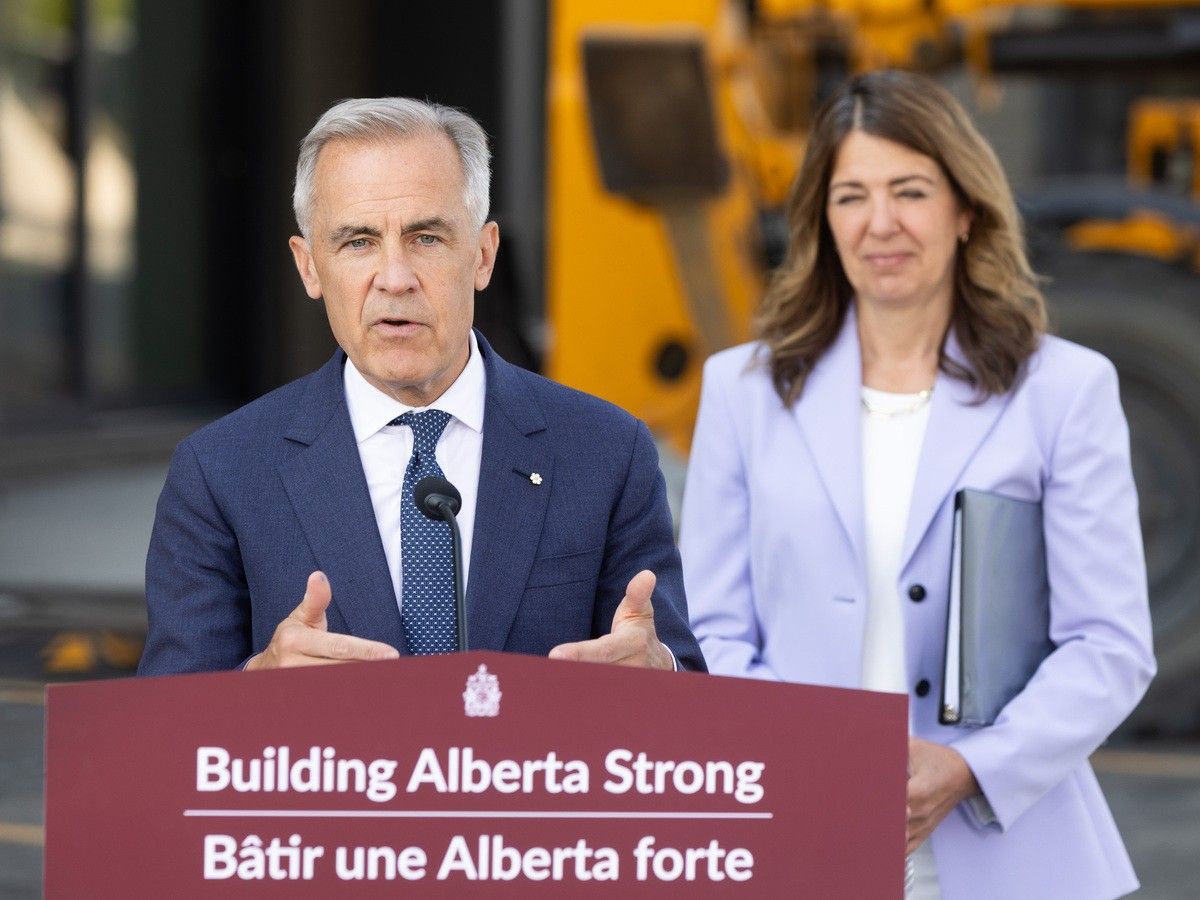
OTTAWA — Prime Minister Mark Carney is tempering talk of cutting off oil exports to the U.S. to retaliate against tariffs.
Carney told reporters in Red Deer, Alta., on Wednesday that turning off the oil taps could threaten Canada’s global image as a dependable energy provider.
“Being a reliable supplier is important… So when you’re a supplier of a key commodity, key service, you’ve got to think really hard about not supplying,” said Carney.
Carney said there were plenty of “other things,” outside of curtailing oil shipments, Canada could do to respond to the U.S. trade provocations.
The prime minister was flanked by Alberta Premier Danielle Smith, who nodded in agreement as he emphasized how important it is for Canadian oil to be seen as a reliable export..
Carney’s comments come as looming 50 per cent U.S. tariffs on a range of Canadian goods have sparked new calls for Canada to hit back by curtailing the flow of the roughly 4.3 million barrels of oil per day it sends across the border.
The White House said in a statement last week that the tariffs, set to start on Aug. 19, were in response to Canadian trade actions, including provinces boycotting U.S. alcohol, Canadian tariffs on U.S. autos, and restrictions on dairy imports.
Ontario Premier Doug Ford said last week that Canada should cut off exports of oil, electricity and potash to the U.S. to make Americans “feel the pain.”
Ford’s idea was quickly shot down by Smith, who said that export restrictions on oil and potash were “not going to happen.” Saskatchewan Premier Scott Moe, whose province is Canada’s sole potash producer, also dismissed Ford’s comments.
Carney suggested he agreed with Smith and Moe on export restrictions, but wouldn’t totally rule out using Canadian energy as a bargaining chip in trade negotiations with the U.S.
“I’m not going to be drawn on what we’re going to do,” said Carney when asked about whether energy would be a part of future retaliatory measures.
Tim McMillan, a partner at Garrison Strategies and former head of the Canadian Association of Petroleum Producers, said that Carney’s words of restraint sent a positive signal to the oil and gas industry.
“(Carney’s) comments about being a reliable supplier, as something that he values, were very good to hear. I think we can infer from them that he may not be picking up on Premier Ford’s desire to see those commodities used as a weapon,” said McMillan.
McMillan added that the industrial carbon tax is already a de facto oil and gas export tax.
Ford first suggested restrictions on oil and potash exports last year, in response to U.S. President Donald Trump’s first round of tariffs, but met immediate resistance from Smith and Moe.
When the Trudeau government briefly floated the idea of putting an export tax on oil shipments to the U.S., in early 2025, Smith refused to sign a joint federal-provincial statement voicing solidarity against the Trump administration’s tariffs.
National Post
rmohamed@postmedia.com
Our website is the place for the latest breaking news, exclusive scoops, longreads and provocative commentary. Please bookmark nationalpost.com and sign up for our daily newsletter, Posted, here.