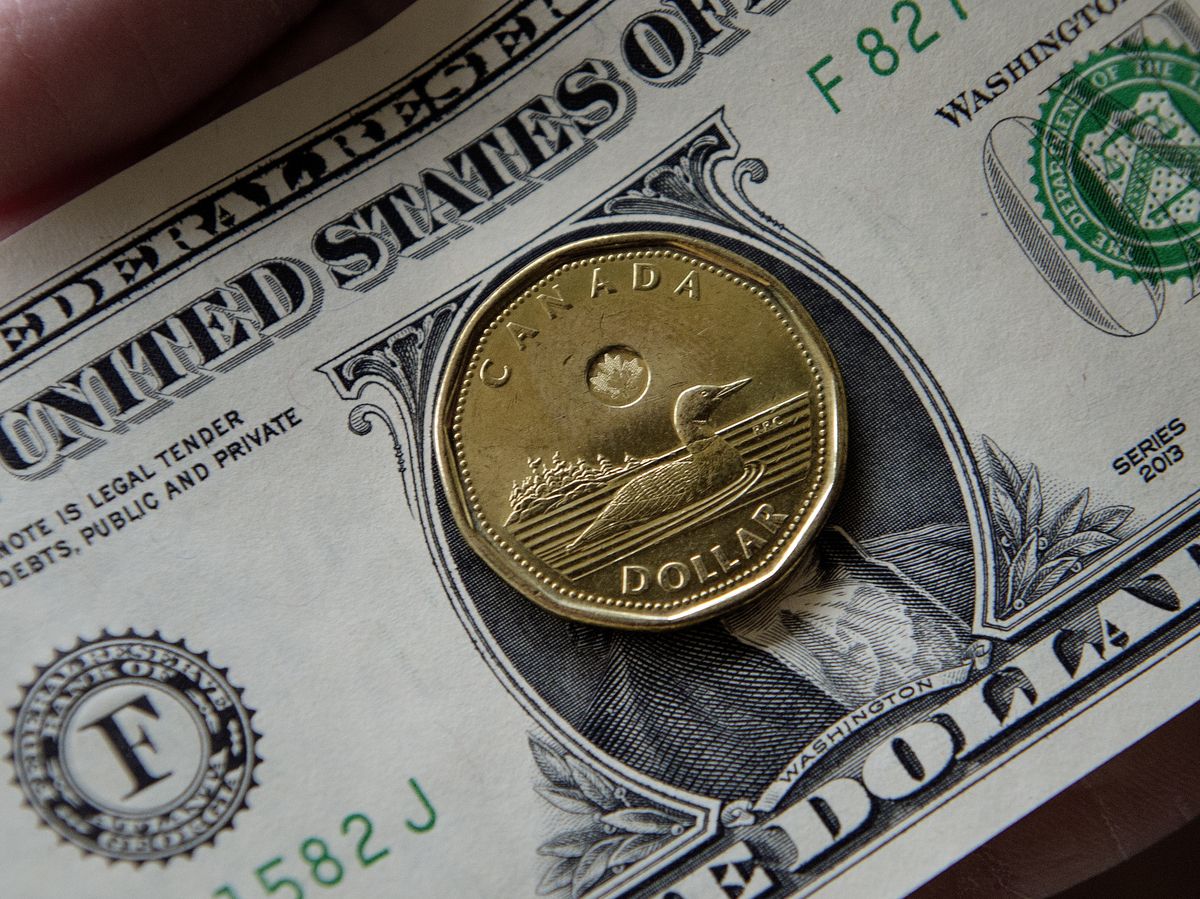
U.S. President Donald Trump opened a new front in the trade war earlier this week, accusing Canada of running a currency “imbalance” two days before Canadian counter-tariffs took effect. “Canada’s (currency) dollar imbalance with the U.S. is unacceptable. It has been that way for years — but no longer!” he wrote in a social media post. What did Trump mean by imbalance, and could the U.S. really target the exchange rate as part of the trade war? The Financial Post explains.
What is a dollar imbalance and where is the loonie trading now?
Trump’s comments about a currency “imbalance” appeared to be in reference to the loonie’s relative weakness compared to the greenback, something that can give a country’s exporters an advantage. The Canadian dollar is currently trading at around 72.37 cents US, or around $1.38 per U.S. dollar.
Loonie weakness isn’t new. The last time the Canadian dollar was at par with the U.S. dollar was in early 2013, after a nearly decade-long commodity boom that lifted it as high as US$1.06 in July 2011.
By January 2016, it had dipped below 70 cents US for the first time since 2003, prompting warnings that the economy was being threatened by “currency instability” that was hurting business and consumer confidence.
For most of the past decade, the loonie has traded between 70 and 80 cents US.
“If you look at full year averages going back to 1970, there’s only a handful of years where, on average, parity was achieved for the full year.” said Vikram Rai, a senior economist at TD Economics. “It’s not normal. It’s fairly rare.”
The loonie has been under more pressure due to the trade war, languishing in the low 70s.
Does a lower loonie help Canada?
The lower loonie is a boon for Canadian exporters . A lower currency makes it cheaper for others to buy Canadian products and more expensive for Canadians to buy abroad. That dynamic has helped drive a wider international trade surplus in recent months.
Canada’s merchandise trade surplus widened to $3.9 billion in June due to higher total exports, which edged up by 0.4 per cent to a record $77.5 billion in June. In real or volume terms, total exports edged up by 1.1 per cent.
At the same time, the average value of the Canadian dollar decreased by 1.7 cents US in June, the largest monthly decrease since October 2022. When expressed in U.S. dollars, Canadian exports actually decreased by two per cent in June, while imports were down by 2.1 per cent.
However, the weaker loonie also puts pressure on production costs.
“It’s not obvious in the long run that a lower exchange rate fundamentally is better for the economy, even if in the short term it does seem to clearly support export demand,” Rai said.
Can the U.S. target the Canadian dollar and how would it do it?
Karl Schamotta, chief market strategist for Corpay Cross-Border Solutions, said it isn’t clear how the U.S. would target the loonie if it tried to.
The U.S. Treasury could add Canada to a watchlist of 10 countries it is monitoring for potential “currency manipulation,” but so far Canada doesn’t meet the three tests to justify the designation — a large bilateral trade surplus with the U.S., a current account surplus above three per cent of gross domestic product and persistent one-sided intervention in foreign exchange markets.
The countries currently on the watchlist are China, Japan, Korea, Taiwan, Thailand, Singapore, Vietnam, Germany, Ireland, and Switzerland.
The Treasury could also intervene and direct officials to buy Canadian stocks and bonds to lift the Canadian dollar, like it did with the yen, but it would be much harder because it is unlikely the Bank of Canada will join the efforts.
Another avenue that could strengthen the loonie would be lower U.S. interest rates.
The United States Federal Reserve ‘s target rate is currently set at 3.5 to 3.75 per cent, while the Bank of Canada ‘s overnight rate is currently at 2.25 per cent. This spread makes the U.S. more attractive to investors because they can get a bigger return on their money, and all things equal, narrowing that gap should boost the loonie.
Trump has been pressuring the Fed to cut interest rates and even threatened to stop trading with all countries that have a trade surplus with the U.S. to put pressure on the central bank.
The Fed, however, sets rates independently and overturning that independence would require an act of law that could potentially destabilize the global economy
Fed Chair Kevin Warsh recently signalled that rate hikes are possible in the coming months if the American inflation rate doesn’t fall to the two per cent target.
“Foreign exchange rates are set by millions of transactions a day, conducted by businesses, consumers, and investors. They’re very hard to influence from a government policy standpoint,” Schamotta said.
What about cutting tariffs?
Rai and Schamotta noted that there is a bigger issue: Despite repeated statements favouring a weaker U.S. dollar, some of the Trump administration’s policies are working in the opposite direction.
“One of the unilateral things the United States could do to increase the loonie-dollar exchange rate would be to remove tariffs,” Rai noted.
“If you place tariffs on a country, it naturally leads your currency to appreciate. The United States has tariffs on many countries, but Canada in particular, and removing those tariffs would lead the loonie to strengthen, most likely.”