
The Bank of Canada could be forced to play catch-up after the United States Federal Reserve hiked interest rates on Wednesday for the first time in three years, one economist says, while others think policymakers still have some room to manoeuvre, though the window to stand pat is closing.
“We’ve actually pulled forward our Bank of Canada call,” Michael Davenport, a senior economist at Oxford Economics Ltd., said.
Oxford now expects the Bank of Canada to hike rates starting in October, with another one following in December. Previously, Oxford called for rates to stay on hold until the fall of 2027.
“We don’t think that they are going to raise rates further than that,” Davenport said. “Our baseline call is that they’ll basically adjust the policy rate back up to a neutral setting.”
Two 25-basis-point hikes would put rates at 2.75 per cent, right in the middle of the Bank of Canada’s target neutral range of 2.25 per cent to 3.25 per cent.
Oxford’s previous call has gone out the window for a few reasons.
It expects oil prices to remain high — they currently sit above US$100 a barrel — for the next six months or so due to the ongoing conflict in the Middle East. It also predicts Canada’s overall inflation rate could rise to 3.5 per cent or even higher this year, though it doesn’t expect inflation to spread to the wider economy.
Inflation for August, the most recent data available, held at three per cent year over year, Statistics Canada said, due mostly to lower gas-pump prices as the global price of oil fell into the range of US$80 to US$85 last month.
“Given that, and the fact that other global central banks are now starting to tighten policy … we think that’s going to sort of tip the balance of risks enough for the Bank of Canada to think, ‘OK, we need to deliver a couple of insurance hikes to get rates back into a more neutral stance in case oil prices do remain elevated,’ and they do start to see that kind of more sustained pass through to other parts of the consumer basket,” Davenport said.
Another reason for a hike is that higher U.S. interest rates and those of other countries will hurt the value of the Canadian dollar, making imports more expensive.
Oxford isn’t alone in thinking a hike is coming at the Oct. 28 Bank of Canada meeting. Bank of Nova Scotia Economics is also calling for a hike next month.
But others say there’s still time to wait.
“Yesterday’s Fed hike is reflective of a global phenomenon where central banks look through the immediate impacts of higher oil prices, but their patience is clearly wearing thin,” Royce Mendes, managing director and head of macro strategy at Desjardins Group, said.
The U.S. economy has been dealing with higher overall and core inflation for a while now, while Canada’s core inflation measures are currently holding around the Bank of Canada’s two per cent target.
Mendes said that gives Canadian policymakers a little more wiggle room on rates, “ but I would say that the limits of their patience are getting closer.”
He said if oil prices remain elevated into early to mid-October, then the Bank of Canada will need to start acting.
Core inflation is contained for now, but Mendes said the Bank of Canada doesn’t want to find itself in a position where it is moving “materially higher” and businesses start raising prices.
“That’s why you want to be preemptive,” he said.
Desjardins is currently calling for the Bank of Canada to hike rates in January, but the risks are so high that the call could be pulled forward into 2026, he said.
“Everything hinges on oil,” he said.
Sign up here to get Posthaste delivered straight to your inbox.

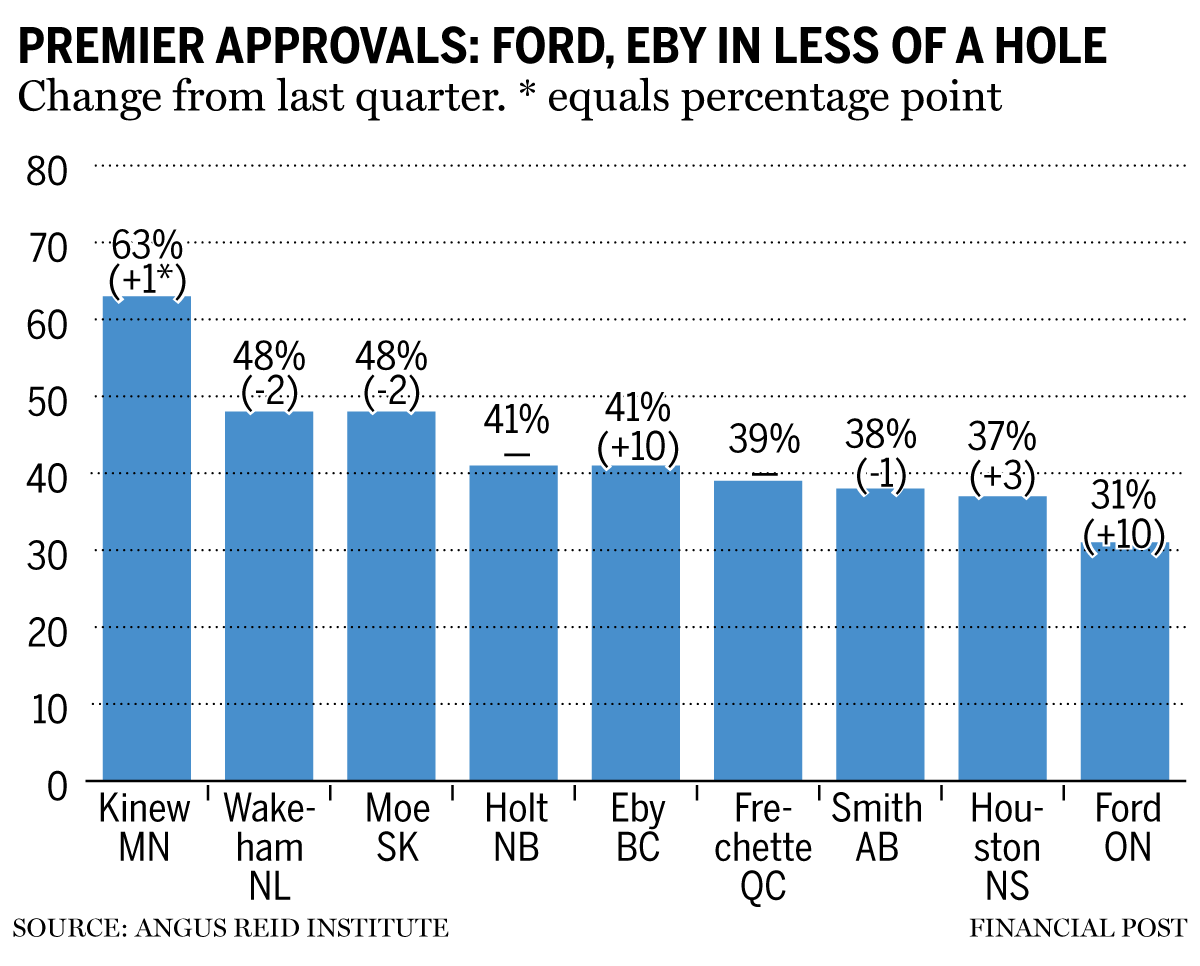
British Columbia Premier David Eby and Ontario’s Doug Ford managed to add significantly to their approval rating thanks to the escalations in the trade fight between Canada and the United States. Otherwise, few provincial leaders seem to be garnering any political upside from the ongoing trade tussle, said the Angus Reid Institute in its latest look at the leaders’ popularity.
“Unlike last year, when the Angus Reid Institute found rising personal popularity for a majority of provincial premiers, few of the provincial first ministers appear to be benefiting this fall, even as trade animosity between Canada and the U.S. intensifies,” the press release said.
Eby and Ford both made significant gains, but the pollster noted those gains lifted their approval ratings out of deep holes, especially Ford.
“For both Eby and Ford, this represents a recovery in what had been flagging assessments from constituents,” Angus Reid said.
Manitoba’s Wab Kinew continues to enjoy a “honeymoon period.”
The pollster conducted the survey of 4,310 people from Sept. 8 to 15. Premiers were only asked about in their home province.

- Today’s Data: U.S. industrial, manufacturing production, capacity utilization
- Earnings: Dayforce Inc.



- From small caps to big winners: 5 stocks that delivered huge gains
- ‘Stellantis ‘100% serious’ about exiting Brampton plant, says union
- Carbon capture CEO says critics ‘told me I was crazy,’ hopes Alberta project proves them wrong

Yvonne, a Canadian-U.S. dual citizen living in Canada, wants to contribute to a registered education savings plan for her two children who are also dual citizens. Although RESPs are non-taxable in Canada, the same can’t be said for the U.S. Internal Revenue Service. She would like advice on how best to report this income to U.S. tax authorities. FP Answers has some suggestions.

The FP Atlantic Economic Report takes you behind the scenes of the business world in Atlantic Canada. We’ll bring you insights from CEOs, government leaders, investors and economists on what’s making the regional economy tick and where it’s heading next. Sign up here
McLister on mortgages
Want to learn more about mortgages? Mortgage strategist Robert McLister’s Financial Post column can help navigate the complex sector, from the latest trends to financing opportunities you won’t want to miss. Plus check his mortgage rate page for Canada’s lowest national mortgage rates, updated daily.
Financial Post on YouTube
Visit the Financial Post’s YouTube channel for interviews with Canada’s leading experts in business, economics, housing, the energy sector and more.
Today’s Posthaste was written by Gigi Suhanic with additional reporting from Financial Post staff and Bloomberg.
Have a story idea, pitch, embargoed report, or a suggestion for this newsletter? Email us at posthaste@postmedia.com .
Bookmark our website and support our journalism: Don’t miss the business news you need to know — add financialpost.com to your bookmarks and sign up for our newsletters here