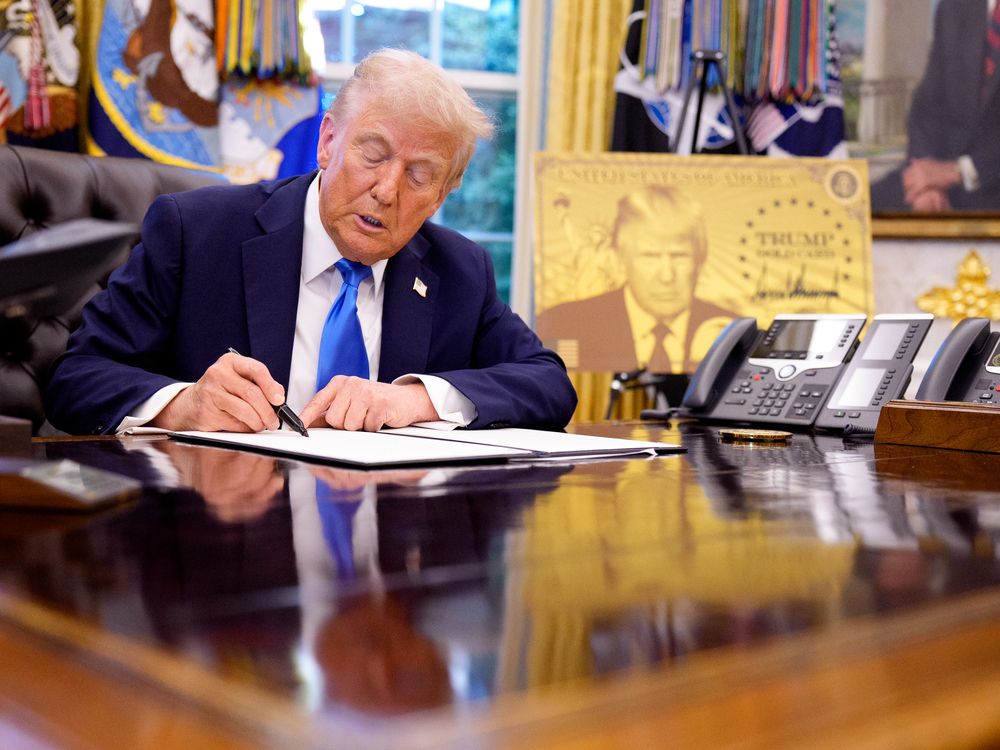
U.S. President Donald Trump last week announced the addition of a US$100,000 new-applicant fee on the H-1B visa, an avenue used by highly skilled workers, including thousands of Canadians, to enter and work in the U.S. legally. Trump said he is imposing the fee to discourage the hiring of foreign workers over Americans, but the move has
sent shock waves through Silicon Valley, which has come to rely on an influx of foreign tech talent, especially from India and China. Canada, which competes with the U.S. for skilled workers from other countries, could stand to benefit from the decision, but as the Financial Post’s Barbara Shecter explains, that is by no means a sure thing.
What changes were made to the H-1B visa program?
Last week, Trump proclaimed that workers applying for an H-1B visa would be refused entry to the United States unless their petitions were accompanied or supplemented by a payment of $100,000. H-1B visas are intended to be used to fill jobs that require specialized knowledge or training and at least a Bachelor’s degree, and there are estimated to be some 800,000 workers in the United States under the program. Employers are required to sponsor the foreign worker and file their paperwork — and, as of Monday, to make sure the new fee is paid. There are thousands of Canadians among the H-1B visa holders, though another type of visa — a TN visa — is more common for Canadians because it simply requires showing proof of employment and prior education at the border.
Trump’s proclamation initially caused confusion about whether the fee would be required for those renewing visas but government officials clarified that it is only for new applicants. The justifications for the change included the suggestion that the program had been “deliberately exploited to replace, rather than supplement, American workers with lower-paid, lower-skilled labour,” which in turn threatened economic and national security “by discouraging Americans from pursuing careers in science and technology, risking American leadership in these fields.” According to the proclamation, the number of foreign STEM (science, technology, engineering and mathematics) workers in the United States more than doubled between 2000 and 2019, while overall STEM employment has only increased by only 44.5 percent during that time.
Does Canada stand to benefit from the latest proclamation?
Yes. Canada’s biggest competitor for top tech talent is the United States, said Benjamin Bergen, president of the Council of Canadian Innovators, and any reluctance among skilled workers to go to the U.S. or employers there to sponsor them creates an opportunity for this country. John Ruffolo, founder and managing partner of Maverix Private Equity, who deals extensively with startups and scale-ups, said Trump’s steep new fee on the visas “opens a window for Canada to focus on
(and) attract the best and brightest in the world to support our access to talent for our digital economy.” However, it’s not a sure thing. Bergen urged the Canadian government to design its response to the moment Trump has created in a way that makes Canada and its homegrown tech companies the most attractive alternative. “Many will look north. But without a clear plan, the majority will end up working at the Canadian offices of foreign firms,” Bergen warned in a statement Monday. “They will build products tied to foreign IP, report to head offices outside Canada, and contribute little to the country’s long-term innovation capacity.”
What can Canada do to draw in high-skilled tech workers and are there any other potential downsides?
Canada’s proximity to the U.S, its world-class research institutions and high quality of living make it a natural destination for those facing a new obstacle south of the border, according to Martin Basiri, a tech co-founder now working as a facilitator for foreign workers and students. But he also warned that U.S. companies now facing a barrier to attracting foreign workers could target Canadian engineers, scientists and healthcare professionals with a workaround to fill the gap created by Trump’s new fees. Recruiting workers from Canada under the alternative TN visa could enable workers to bypass the H-1B fee altogether, said Basiri, who co-founded study-abroad application platform Applyboard and served as its CEO until 2022. “Canada is an ideal target for this kind of poaching, with a deep pool of highly educated talent, shared cultural values, and native English fluency,” he said in an assessment posted to the website of Build Canada, a platform launched by founders and entrepreneurs to advance policy ideas. Basiri, whose latest venture Passage is building AI tools to assist in global talent mobility, said it’s too soon to have seen the effects of the new H-1B fee. “I have not heard anything (yet), but the risks are big,” he said.
What could the Canadian government do to take advantage of this change?
would like to see more coordination between companies and the government to boost the potential to match workers to needs. The Council of Canadian Innovators would like to see a program created in 2023 to draw skilled workers to North America resurrected and tweaked. It allowed anyone with a valid H-1B Specialty Occupations visa living in the United States to apply for an open work permit to work in Canada for up to three years, but closed quickly after reaching its cap of 10,000 applications. The program could be reopened with a specific focus on skills most in demand by Canadian tech companies, sending a signal that Canada is open to skilled talent immigration. “The demand is clear. Now we need to rerun that plan, but with better targeting,” said Bergen. “We should tailor criteria to the most sought-after skill sets and create stronger pathways that connect this talent to Canadian scale-ups.” Another avenue for recruitment of skilled workers would be to add a “global top-100 university express track” to Canada’s permanent resident application and award additional points to graduates from elite institutions such as MIT, Harvard, Stanford and Tsinghua University in Beijing, said Basiri. “This targets the same talent pipeline that previously produced major tech executives in the U.S. and will now be looking for alternatives.” With the U.S. becoming less inviting, he, too, suggested reopening and adapting the 2023 work permit program. Open permits could be replaced with closed ones that would allow current and prospective H-1B visa holders to live in Canada while working for U.S. employers for up to three years. Set salary thresholds could help ensure foreign workers don’t displace Canadians that are qualified to do the jobs. “America’s $100,000 H-1B fee just created the biggest talent acquisition opportunity in Canadian history,” Basiri wrote.
• Email: bshecter@postmedia.com