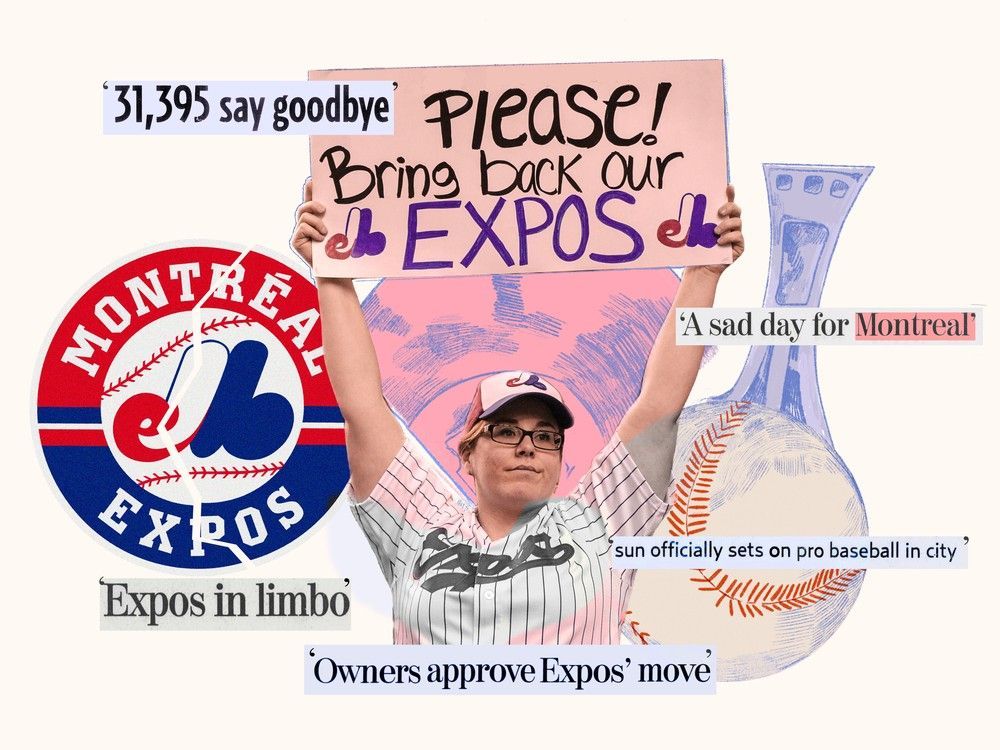
Who killed the Montreal Expos?
It’s the title of a recent Netflix documentary, but it’s also a question on the lips of many Montrealers — part of a debate that has been reignited since the film made its debut a few weeks ago. Then the Blue Jays lost the World Series title to the Los Angeles Dodgers, triggering even more nostalgia for the Expos.
The Gazette spoke to three people closely tied to the Expos to weigh in on the question.
Mark Routtenberg was one of the members of the consortium that owned the Expos in the years leading up to their demise in 2004.
David Samson ran the Expos when New York art dealer Jeffrey Loria bought a 24-per-cent stake in the team for $18 million in 1999 and became the controlling partner.
Both Routtenberg and Samson were quoted at length in the documentary.
Stephen Bronfman, the force behind a campaign in recent years to try to bring Major League Baseball back to Montreal, was not interviewed for the film. His father, Charles Bronfman, was the team’s original owner from 1968 to 1991.
Here’s what they had to say:

Mark Routtenberg
Montreal businessman Mark Routtenberg puts a lot of blame for the demise of the Expos on the 1994-95 Major League Baseball strike.
“That was the beginning of the ruination of the club,” Routtenberg said.
The Expos had the best record in baseball at 74-40 when the strike began on Aug. 12, 1994, and the season was subsequently cancelled. Many pundits and fans were convinced the team had an excellent shot to reach the World Series and win it that year.
After the strike finally ended on April 2, 1995, Claude Brochu, the managing partner of the consortium of owners, orchestrated a fire sale, getting rid of many of the Expos’ best players to slash payroll. Outfielder Marquis Grissom, starting pitcher Ken Hill and closer John Wetteland were traded for little in return and star Canadian right-fielder Larry Walker left via free agency. The team ended up finishing last in the National League East Division that season and it’s fair to say the franchise never recovered.
“That was the beginning of the end of my friendship with Claude Brochu,” Routtenberg said. (Claude Brochu declined a request for an interview.)
The team couldn’t afford to pay the players because the partners wouldn’t pony up the needed cash.
“My partners were stupid,” Routtenberg said. “Who were my partners? They were heads of corporations who knew f— all about baseball and sports. Except maybe one or two. Quebec Inc. zero. They didn’t even want to come to games at the beginning.”
The ownership consortium that bought the team from original Expos owner Charles Bronfman in 1990 included the Desjardins Group, the Jean Coutu Group, Routtenberg and many others. (Among them: Bell Canada, Provigo, Canadian Pacific, the Solidarity Fund of the Quebec Federation of Labour and even the City of Montreal.) The central problem, Routtenberg believes, is that his partners weren’t willing to put in more money to create a competitive baseball team.
“I blame everyone; I blame Stephen (Bronfman),” Routtenberg said. “I didn’t have the money to step up. I wasn’t a billionaire partner. (Bronfman) is one of hundreds I could blame in the wealth category. Look around today. Any billionaire would love to buy a sports team.”
“Loria had it right from Day 1,” Routtenberg explained. “He’s an art dealer. So he understands supply and demand. He said: ‘There’s only 32 of them in the world. It has to go up in value.’ He understood. You want to be part of that club. You have to pay. So what’s happening today? The values (of North American sports franchises) have gone up from US$100 million a club to US$1.5 billion to US$2 billion a club to sometimes US$10 billion.”

When Loria made mandatory cash calls, and the local owners were not willing to put in that extra money, their percentage of ownership shrank drastically.
In the end, Loria acquired 94 per cent of the team and the Expos were sold to Major League Baseball for US$120 million in early 2002. That gave Loria most of the money he needed to then buy the Florida Marlins for US$158.5 million. After two years of being run by the league, the Expos would be dead. The team was moved to Washington in 2004 and became the Washington Nationals.
Routtenberg said he tried to convince Céline Dion and her husband, René Angélil, to buy the team, even letting Angélil on the field one night at the Olympic Stadium with the players after the game. But that didn’t come to anything.
Routtenberg said he was key in bringing Loria into the Montreal Expos organization and at first he thought he was a good fit as owner.
“The minute the deal went through … I was getting some negative signals,” Routtenberg said. “(Loria) always knocked everything. That bothered me.”
Loria immediately said they needed a new stadium and it quickly became clear the provincial government was not going to fund it. Things just got more sour, Routtenberg said. There was no small amount of animosity toward Loria and Samson. Routtenberg said one day, just outside the Expos’ dressing room at the Big O, a local cameraman punched Loria in the face.
“I said to Loria, ‘Are you crazy? You know you’re hated in Montreal and you go around without protection.’ From that day on, he had security.”
In the end, many deserve blame, Routtenberg said.
“It’s a collective blame,” he said. “The partners, including me. I blame me because we ended up with Loria, but there was nobody. Number two, blame me because I couldn’t convince Brochu not to have the fire sale.”

David Samson
According to David Samson, the Major League Baseball commissioner Bud Selig wanted a local owner for the team when it was up for sale during the late 1990s but no one from Quebec was willing to take the chance.
“Every local businessman had an opportunity to invest in that team,” Samson said in a recent phone interview from his home in New York.
“And it was not a big investment. I remind you, Jeffrey Loria’s investment was $18 million Canadian in 1999. This was not the era when franchises were worth $5 billion.”
Samson said no one was willing to buy the team because “the team was losing money every year. There was no path to a new stadium without governmental support. I didn’t know this when I started because I was told there was governmental support. The commissioner said it’s going to be hard, but it’s possible to get governmental support. The Canadian partners who we were negotiating with said there is governmental support for a new stadium.”
But Samson said it became very clear to him after a few meetings with the government “that they were never going to invest in a new stadium in Montreal. And that was the end. The team couldn’t stay at Olympic Stadium; the MLB would not allow it.”
In the Netflix documentary, Samson says he accepts a small part of the blame for the Expos’ collapse. In our conversation, Samson said the real culprit was the consortium of Quebec minority owners.
“You have to remember who the limited partners were,” Samson said. “They were the top businessmen in Quebec. These were not schleppers. These were very successful, very important people. These were not men on the street who were the partners in the Expos. These were the biggest corporations and the wealthiest people in Montreal.

“It’s insane to me that none of them thought to want to run the Expos, but then they needed to make sure to blame an American when it failed so they would have separation from it. It’s funny, isn’t it? They think we set them up, but I’m laughing because I think they set us up.”

Stephen Bronfman
At that time, Stephen Bronfman had a small stake in the Expos. He echoed Routtenberg’s claim that the local owners who were part of the consortium didn’t understand the baseball business. And Bronfman said the real problem was the fact that there wasn’t one business leader willing to take a chance on the team.
“Back then, there was a chance, but nobody would step up,” Bronfman said. “No one was there.”
It was the same era when Molson Breweries put the Montreal Canadiens up for sale — in 2000 — and there wasn’t a single Quebec or Canadian suitor for the most storied franchise in hockey. In the end, Molson sold an 80.1-per-cent stake in the Montreal Canadiens and 100 per cent of what was then called the Molson Centre to American entrepreneur George Gillett Jr. for $275 million in early 2001.
“Same thing — it’s not a good look,” Bronfman said. “That’s why George Gillett came in and got a sweetheart deal.”
Asked who is to blame for the death of the Expos, Bronfman said: “All of the cast of characters involved since my dad’s sale because nobody would step up, nobody. I don’t have a great taste in my mouth for certain folks, but everybody was to blame, myself included.”
Back then, Bronfman didn’t feel it was the right time for him to make a bid to control the team.
“I felt badly,” Bronfman said. “I was not of the age to say, ‘OK, dad, I’ll take it over.’ It wasn’t that time. My dad was doing the civic thing when he originally sold it. He had gotten some big offers, one from Florida, one from Buffalo. And he said, ‘No, I’ve built this franchise in Canada and if I can, it will stay here.’ And he forewent a lot more money and sold it to a consortium (of Quebec owners).
“You know the story. It was a who’s who of Quebec Inc. and I think they did an honourable thing to put in a certain amount of money to keep the team. But they didn’t understand the nature of sports and people weren’t willing to put in the plus-one dollars that were required to keep it up to speed,” Bronfman said.
“And Montreal became like a Triple-A development team that built players and sold them off because we couldn’t afford the salaries. Larry Walker said he knew that (1994) team would’ve won one or two, at least, World Series. He told me when he was in Montreal a while back that had we been able to do that, we’d have baseball here today.”
In recent years, Bronfman made a serious run at bringing MLB back, trying to arrange a deal to share a team with the Tampa Bay Rays.
“By the time I grew up and started taking a serious look at the baseball situation in Montreal, we had something that was fantastic a couple of years ago. But then it was shot down by Major League Baseball,” Bronfman said.
Neither Stephen Bronfman nor his father, Charles, were interviewed for the Netflix documentary.
“I actually reached out to them just to get a sense of what they were doing,” Bronfman said. “I was a little concerned about this Netflix enquête into the Expos and not having any contact with dad or me. I was a little ill at ease that no one wanted to speak to us. I was like, ‘Whoa, what’s going on? Is this an unauthorized biography?’ I reached out to the producer and we talked and I was OK afterward. But I was a little ticked off that I had to hear about it through hearsay that this project was going on.”
But Bronfman understood that “maybe they didn’t want to have the family perspective on it, that they wanted to do their own thing.”
Sophie Charest, one of the producers of the Netflix documentary, said they met with Stephen Bronfman but made an editorial decision that they didn’t need to include him in the film. Charest also said they did not include Charles Bronfman, the team’s founder, because the film focuses on the last 10 or 15 years of the team, not the era when Charles owned the team.
Bronfman said Loria and Samson knew the baseball business well before they came to Montreal.
Loria and Samson “looked at all the teams and they saw this dysfunctional partnership and they played this auction game. And it was all legit.”
Loria would do the cash calls, the partners would decline “and he just kind of scooped it up.”
Bronfman isn’t willing to say they came in with a plan to use the Expos as a stepping stone to buy another team. They just seized the opportunity, he said.
“I think they didn’t necessarily know what they were going to do. I think they looked at it and said, ‘Here is a good opportunity to get in.’ And once they learned more about the market, they were like, ‘Whoa this is not happening here and let’s try to figure out a way to (get another team).’”
Bronfman said he had the impression Samson didn’t want to put down roots in Montreal. Bronfman gave him advice about real estate and schools, but Samson “didn’t really want any of that. … It felt like they’d be running this thing from New York and they didn’t really want to be here.”
Bronfman said relations were frosty between Loria and the Quebec partners from the get-go.
“The worst time was when we all went down to West Palm Beach (in Florida) for the first partnership meeting when they became owners and it was spring training. We had two days of meetings and Loria had his own tickets and he put all the French-Canadian partners in different seats away from their own little area. It was not a friendly situation. He didn’t want to be with any of them. It was very uncool … so there were these little things,” Bronfman said.
“Okay, (Samson) doesn’t want to go look at the schools or look at real estate. They won’t sit with us at the games. It doesn’t take a rocket scientist to figure out there might be an ulterior motive,” he noted.
“Look, they’re smart guys. They saw an opportunity and they’d studied it and they probably had a couple of plans. And as they got to understand the Montreal market more, they were like, ‘Whoa we’ve got to do something different because this is not happening.’”
It was a business decision, Bronfman noted, adding that they came into a tough market.
“Our fair city was not good to the baseball team ever since the days (when my dad owned the team). After dad, forget it. It’s been an unfortunate downhill story since, and such is life. And we came so bloody close recently. But back then, nobody would step up.”