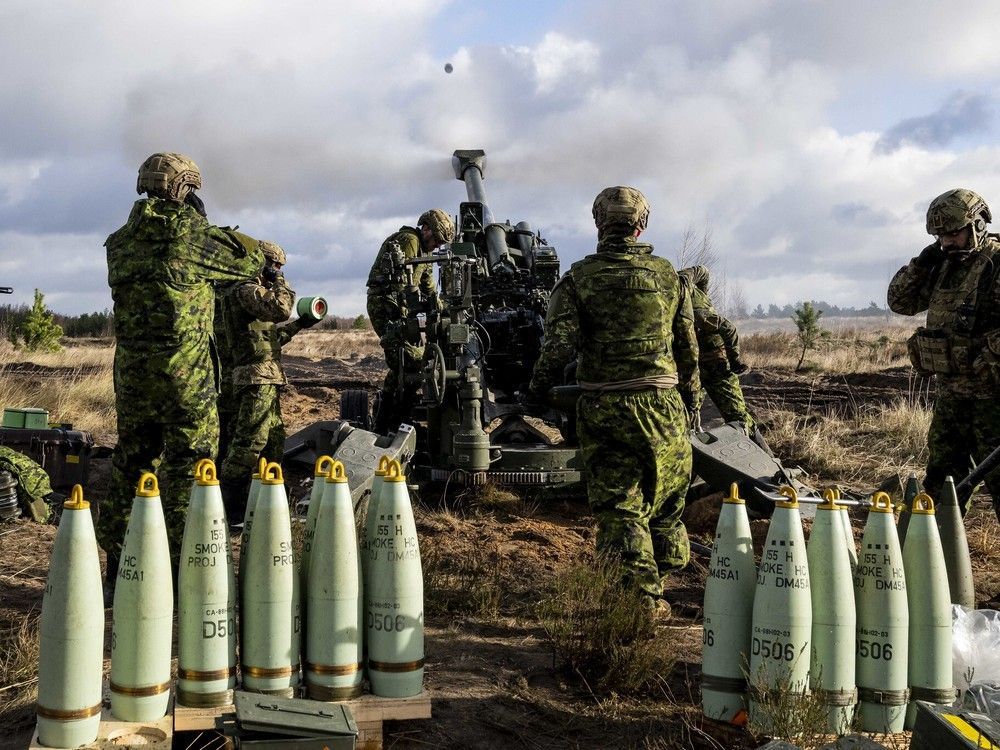
A new Canadian Army equipment program that could be worth almost $500 million is designed to select only U.S.-provided equipment, despite claims by Prime Minister Mark Carney the military will be reducing purchases of American systems.
The Joint Fires Modernization program will cost between $250 million and $499 million and
see the acquisition of hardware and software
to enable the Canadian Army to digitally share data and targeting information between its various units and coalition forces.
But the technology for the Joint Fires Modernization will be acquired through the Foreign Military Sales (FMS) process with the U.S. government, according to the draft request for proposals provided to the defence industry.
Not only does that exclude Canadian and European companies from bidding but the FMS process
—
which is a direct equipment purchase from American companies via the U.S. government
—
does not require any industrial benefits for Canada.
Multiple defence industry officials contacted the Ottawa Citizen to raise concerns about the Joint Fires Modernization program, complaining that army commander Lt. Gen. Michael Wright and Defence Minister David McGuinty are ignoring domestic firms and European companies for upcoming major equipment programs.
Those contacting the Ottawa Citizen did not want to speak on record about their concerns for fear of jeopardizing future efforts to obtain government contracts.
But a review of the draft request for proposals clearly outlined the requirement for U.S. technology. “All components of the Digital Joint Fire Support C2 software will be used in conjunction with the Advanced Field Artillery Tactical Data System and subsequently the AFATDS Artillery Execution Suite, available to Canada via Foreign Military Sale,” noted one of the requirements.
Other key components of the project require modules and software that only American firms have access to through the U.S. government.
Radios to be used are those operated by the U.S. Marine Corps and U.S. Army and which are only available to American suppliers via the U.S. government. Standard Canadian military radios are not included in the requirements.
Neither Wright nor the Canadian Army responded to a request for comment. McGuinty did not respond to a request for comment.
Initial delivery of the new system would be set for 2026, according to the Canadian Forces.
During a June 9 speech,
Prime Minister Mark Carney repeated an earlier promise
that Canada would cut back on using its defence dollars to purchase U.S. military equipment. The U.S. has become increasingly hostile to Canada, with U.S. President Donald Trump continuing with his economic efforts to punish Canada and push for this country to become the 51st state.
“We should no longer send three-quarters of our defence capital spending to America,” Carney said. “The transformation of our military capabilities can help with the transformation of our economy.”
But there has been growing frustration among some Canadian defence firms that the Canadian military is ignoring Carney’s call to decrease reliance on U.S. suppliers. Canadian military leaders are extremely close to their U.S. counterparts and despite the prime minister’s direction have advocated for increased ties to the Americans.
The recent sole source purchase
of the U.S. High Mobility Artillery Rocket System or HIMARS also contributes to the use of American-only equipment for the Joint Fires Modernization program.
The Joint Fires equipment will be used to co-ordinate artillery and rocket capabilities on the battlefield.
South Korea
had pitched Canada on its alternative
to HIMARS which Poland recently purchased as part of its arms buildup to counter Russian aggression.
South Korean companies pointed out that they were not only offering industrial benefits to Canada but sovereign control over the technology. That level of control over military systems is a particular area of concern for a number of nations considering some of the issues that have emerged with U.S. equipment. Ukraine, for instance, has used HIMARS in combat against Russian forces, but earlier this year the Americans were able to reduce the effectiveness of the weapon system by limiting the flow of data and intelligence needed for its operations.
Despite the significant amount of U.S. control over HIMARS, the Canadian Army leadership convinced the Liberal government to go ahead and purchase the American system.
However, that equipment won’t be delivered until at least 2029.
The estimated total cost is US$1.75 billion
or CDN$2.4 billion and the principal contractor is Lockheed Martin, located in Texas.
The Canadian Forces and Department of National Defence did not respond to a request for comment on HIMARS and what industrial benefits, if any, were to be obtained for the more than $2 billion in spending.
The
Ottawa Citizen also reported Nov. 19
that the Canadian Trade Tribunal issued a recommendation to reboot $100-million Canadian Army project to buy night-vision equipment in the wake of allegations the proposed purchase was designed to favour U.S. manufacturers.
Canadian and European companies had complained about changes brought in by the Department of National Defence which put emphasis on U.S. products, according to government documents discussing the procurement. In a series of written responses to the government, the companies noted the changes restricted the purchase to equipment sourced exclusively from the Americans.
In addition, the companies were told that the level of Canadian content in equipment to be tested would not be taken into consideration during the evaluation of systems.
The federal government is aware of the tribunal decision “and is determining next steps,” Public Services and Procurement Canada spokesperson Michèle LaRose stated in an email.
David Pugliese is an award-winning journalist covering Canadian Forces and military issues in Canada. To support his work, including exclusive content for subscribers only, sign up here: ottawacitizen.com/subscribe