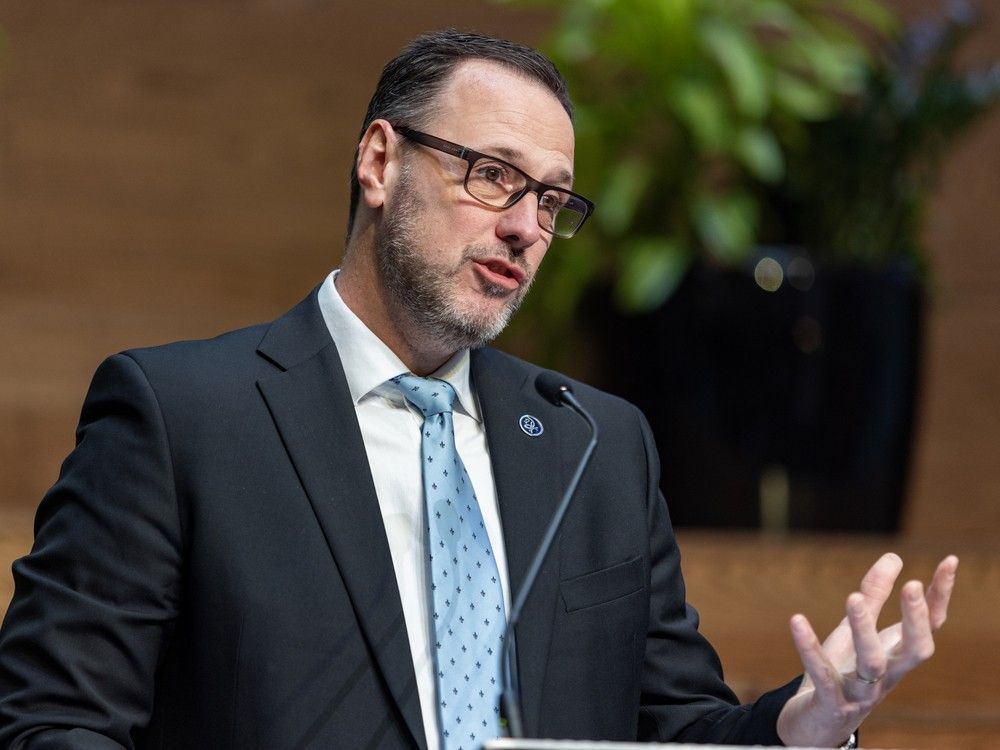
Jean-François Roberge opened public hearings into Bill 9, the Quebec government’s latest attempt to strengthen secularism in the province, by reminding those present that Quebec’s laicity movement is not against certain religions.
The minister responsible for secularism said that since the 1960s, Quebec has been working steadily toward religious neutrality, and Bill 9 is the continuation of that effort.
The bill would, among other things, extend the ban on religious garb and symbols to those who work in daycare centres subsidized by the state, forbid group prayers in public spaces unless expressly authorized by municipalities, and forbid public institutions like hospitals and daycares from exclusively offering food based on religious dietary laws.
“Many people say, ‘Oh, secularity is against certain religions, but you don’t want to touch the religions that were here for so long.’ Sorry, but the first actions taken were to end classic (religious) colleges and end Catholic and Protestant school boards,” Roberge said Tuesday.
Roberge repeated the four fundamental principles of secularism that his bill is intended to reinforce. These include separation of church and state, religious neutrality of the state, equality of all citizens and freedom of conscience.
The new bill, called
An Act Respecting the Reinforcement of Laicity in Quebec
, continues the work of Bill 21, Quebec’s existing secularism law.
Secularism group wants law extended to more staff
At the hearing on Tuesday, some groups argued Bill 9 goes too far, while others said it doesn’t go far enough.
Nadia El-Mabrouk — president of the Rassemblement pour la laïcité (RPL), a collective of groups working toward secularism in Quebec — was mainly in the latter camp.
Her collective recommends the bill’s provisions be extended to youth protection staff and to the Quebec human rights and youth rights commission.
She welcomed many of the bill’s proposed measures, such as withdrawing government subsidies from daycares that admit children based on their religion, and a ban on prayer rooms and on the wearing of full face coverings in all educational institutions, from daycare to university.
“We think all these measures allow for the concrete reinforcement of the secularism of the state, and the right of citizens to secular public services,” she said.
El-Mabrouk said the bill should apply to public and state institutions, but warned the government against imposing secularism on public spaces, such as parks and streets.
“Speaking of religious neutrality of public spaces gives ammunition to all the attacks (on secularism), deforms the concept of secularism and transmits a very bad message to the public. This is why we are asking you to abolish this concept and to rename this bill so that it is clear that secularism applies to the Quebec state and not to public spaces.”
She said group prayers held in the streets in the context of protests in support of Gaza affected the social climate and “we must be concerned about this.”
“But the remedy must not be worse than the illness,” she said.
Bill 9 would forbid any use of public roads or parks for group religious practices, except with special authorization of the city council.
“But how to differentiate a religious practice from a non-religious practice?” El-Mabrouk asked. “Why forbid a baptism, a meditation session or a religious procession? How to justify targeting religious gatherings rather than non-religious protests that might disturb public spaces but are not forbidden?”
Her group recommends the bill forbid public institutions from offering foods that respect religious dietary laws. The bill as it stands prohibits institutions from “exclusively” offering these foods.
“This kind of accommodation represents an excessive constraint for an institution,” she said.
El-Mabrouk welcomed the idea of extending secularism requirements to government-subsidized daycares.
“It is up to the state to ensure that in its institutions, under its supervision, children evolve sheltered from all religious pressure,” she said.
Union wants moratorium for further study
The bill includes a grandfather clause that would allow those hired before the law is adopted to continue wearing religious symbols on the job, although they could not change employers or be promoted.
But representatives of daycare employees called on the government to hold off on this part of the legislation until research is provided on how it would affect Quebec’s daycare system.
“We are not asking you to throw it in the garbage. We are asking for a moratorium to be able to evaluate exactly what the impact will be,” Pascal Côté of the Centrale des syndicats du Québec told the commission.
Daycares worry about making staff shortage worse
Anne-Marie Bellerose, president of the Fédération des intervenantes en petite enfance du Québec, said staff turnover rates at public and private daycares are so high that there is real concern the bill would deprive many families of service. As things stand, some 30,000 families are waiting for daycare spots.
“We agree with secularity. The pedagogic program is secular. There is no religious teaching in daycares … but what will we do the day when we have no staff?”
But El-Mabrouk of the RPL said that concern only underlines the high number of daycare employees who wear religious veils.
“Those who are opposed to the ban on the wearing of religious symbols by daycare staff say it is impossible because too high a number of veil-wearing women work in these daycares and we have a labour shortage. That is recognizing that a religious climate is already well implanted. And that is worrisome. At the RPL, we don’t think it’s too late, but we have to act now before it is.”
Droits collectifs Québec wants clearer definitions
Étienne-Alexis Boucher, executive director of Droits collectifs Québec, spoke generally in support of the bill, but his group proposed several amendments to strengthen it and reinforce its legal sustainability.
He said the bill should explicitly include the right of citizens to secular public services, and should clearly define the notion of “collective religious practice” so that it targets organized and structured group activities, and not individual manifestations of religion, such as a couple of people praying together on a park bench.
Boucher’s group also advocates for the secularism minister to “keep a role of surveillance and control,” rather than leave it to the discretion of municipalities to authorize religious gatherings.
“Secularism is a national norm and should be applied in a uniform way across Quebec’s territory,” he said.
The hearings continue on Wednesday.