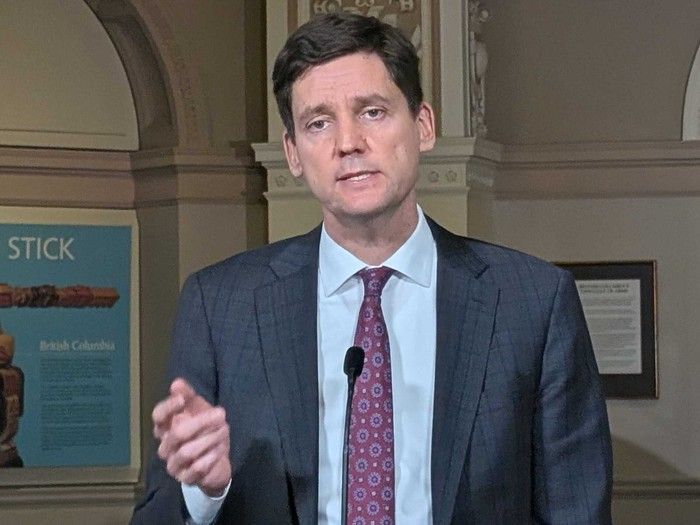
B.C.’s premier told First Nations during a two-hour meeting on Thursday that the province will be suspending the vast majority of the Declaration on the Rights of Indigenous Peoples Act for the next three years and holding off on previously proposed amendments.
David Eby said Thursday that Indigenous leaders were adamant that his previously proposed amendments were unacceptable. Those amendments would have limited which laws the declaration law, also known as DRIPA, applied to.
“We heard loud and clear that this approach was totally unacceptable to First Nations leaders, that it reflected government unilaterally drafting changes to a law that we had worked on together to write, and they felt the process was rushed and that the entirety of that approach was wrong,” said the premier.
“We took that feedback back, and we withdrew that proposal.
“Today, I presented another proposal to Indigenous leadership that responds to government’s concern about legal liability, but also seeks to respond to the Indigenous leadership’s concern about preserving the act.”
A senior official from the premier’s office told reporters on the condition of anonymity that the amending legislation will be introduced at some point after the Easter break week and will not affect sections 6 and 7 of the act, which allow the province to enter into decision-making agreements with First Nations.
The official said the changes are needed to protect the government from having legislation shot down by the courts even as it asks the Supreme Court of Canada to review the B.C. Appeal Court’s December ruling that B.C.’s Mineral Tenure Act is not consistent with DRIPA.
Eby said the suspension legislation will be a confidence vote and brushed off concerns that any members of his caucus, which includes three Indigenous MLAs, will vote against the legislation.
Robert Phillips of the First Nations Summit said he doesn’t agree with any pause or amendments of DRIPA, calling it a step backwards for reconciliation.
“Whether you’re going to amend, whether you’re going to cut it all out and take it all out, or whether you’re going to propose some pauses, you know, we do not agree with any of those approaches,” said Phillips.
“Meaningful consultation hasn’t taken place. … It’s almost like a take it or leave it. And you know, we would prefer to leave it. And I believe the premier’s got himself in a corner here politically.”
Hereditary Chief Shana Thomas of the Lyackson First Nation said that the issue of the Mineral Tenure Act decision is a “faux issue” and does not mean all B.C. laws need to be amended to be consistent with DRIPA.
Thomas said the real problem is the lack of treaties in B.C., unlike the rest of Canada, between the governments and First Nations, which has left many nations without traditional rights and title on their land.
She also took issue with the premier putting one set of amendments on the table, only to pull them at the last minute and introduce a suspension of DRIPA.
Many chiefs and Indigenous representatives had worked hard to come up with a response to the original proposal, said former Green MLA Adam Olsen, a member of the Tsartlip First Nation, with the premier then coming in and completely throw it out the window.
“Only he knows the details of it, only the government knows the details of it. I don’t believe I’ve seen anything come from the government in terms of documentation, or anything that outlines exactly what the premier’s proposal is, and then he’s in the media talking about the proposal,” said Olsen.
“It is jarring, and it’s very, very challenging to be operating in an environment like that. When a lot of the leaders have got other members of council, they’ve got their community, they’ve got their legal advisers, really no opportunity to be able to do a full assessment on the fly, which isn’t reasonable.”
He also said it is “heartbreaking” to see the direction the province is heading, almost seven years after DRIPA, which Eby played a large role in drafting as attorney general, received unanimous support in the legislature.
Opposition Leader Trevor Halford said the province’s backing away from the amendments in favour of simply a suspension of DRIPA is tantamount to the NDP “hitting the panic button.”
He said the change in position also creates more uncertainty on the issue and that he should simply do what the Conservative are asking and repeal the legislation.
“Even yesterday, he said that he was going to be bringing forward amendments to deal with this,” said Halford. “DRIPA has to go, and we’re ready and willing to work with the government on a new path forward.”
Green MLA Rob Botterell said his party is waiting to hear what First Nations say before making a decision on whether to support suspension.