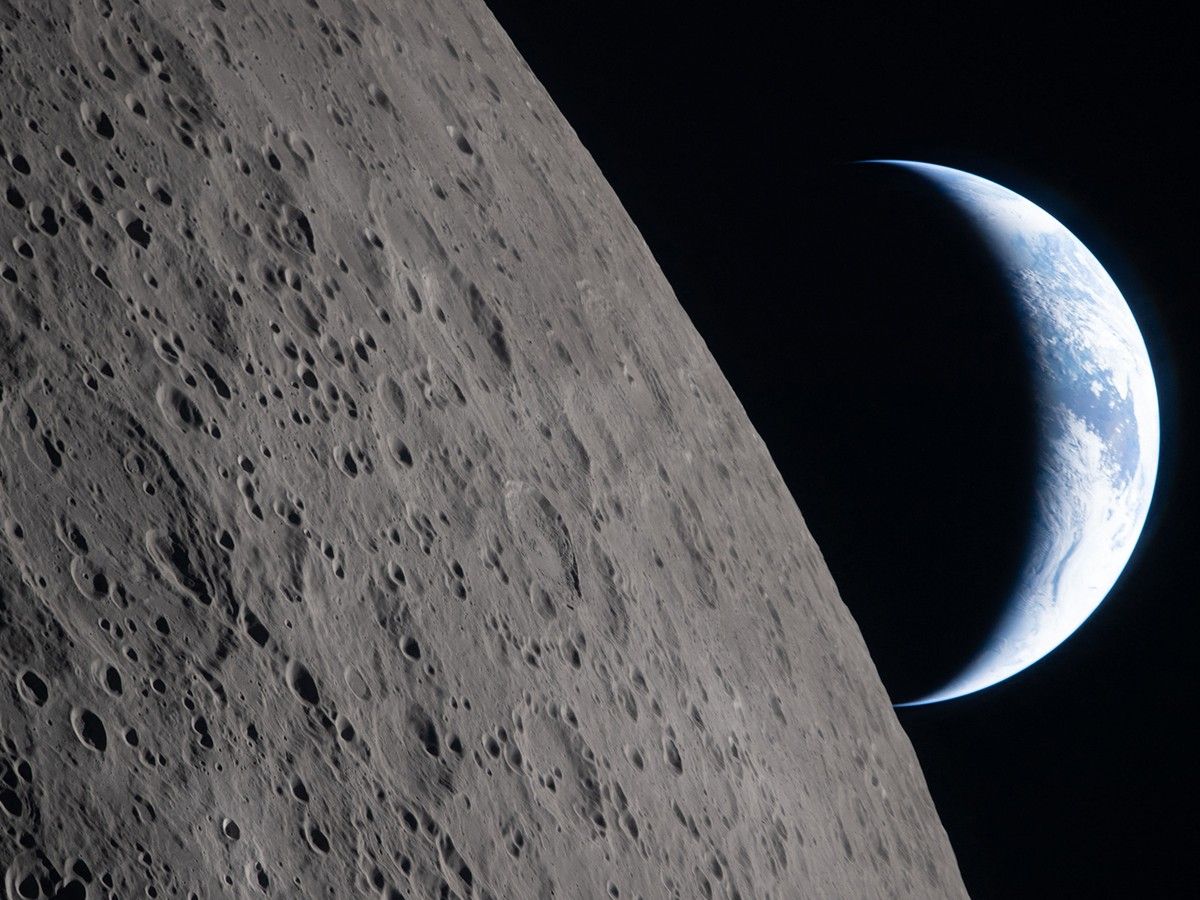
As humanity returned to the moon for the first time in more than 50 years on Monday, photos and videos of Earth’s only natural satellite proliferated at the speed of the Artemis 2 spacecraft that took four NASA astronauts there.
And while some of those are, in fact, authentic images and videos of the moon, they weren’t captured during the historic mission, but by people observing from afar through a telescope and high-end photography equipment.
The official handouts from the space agency show a grey, colourless moon, but among those being passed off online as captured from the Orion capsule, one shows a surface peppered with hues of red, brown, orange and dark blue across vast swathes and craters.
As stunning as they are, the inaccuracy was highlighted by users on X.
“The highest quality video of the moon was just released… this is so beautiful,” Physics & Astronomy Zone, a verified account with more than 250,000 followers, wrote on a close-up video panning from right to left across the moon’s battered shell.
The highest quality video of the moon was just released… this is so beautiful. pic.twitter.com/0JLkB0tOXv
— Physics & Astronomy Zone (@zone_astronomy) April 7, 2026
Keen-eyed observers, however, traced the source to an Instagram user and Ukrainian photographer
, who used an old DSLR camera to take tens of thousands of images and “create a detailed mineral image.”
“To achieve this level of detail, I processed tens of thousands of frames captured with a 150mm telescope and Canon 550D DSLR camera,” he wrote in his post. “Nearly 50 GB of raw data were meticulously stitched together to produce this final 50-megapixel image, which reveals the chemical composition of the lunar regolith.”
His image was also shared on Facebook with the suggestion that it was taken this week.
Another video of the moon recorded from
Texas-based astrophotographer Adam Jackson
’s backyard has also “been making the rounds all across the world,” he said, often purported to be videoed about 380,000 kilometres away in space.
“This might be the most detailed Moon image ever captured,” wrote user
, who appropriated and shared the video and mined Jackson’s social channels to find out the precise equipment used.
“1,000 frames stacked using a Nikon Z8 and Takahashi TSA-120 telescope, producing a stunning 40MP masterpiece,” he added, mirroring what the original creator wrote on Instagram.
This might be the most detailed Moon image ever captured
1000 frames stacked using a Nikon Z8 and Takahashi TSA-120 telescope, producing a stunning 40MP masterpiece pic.twitter.com/9dBMWlEXvh
— Surajit (@surajit_ghosh2) April 6, 2026
Portugal-based digital outlet
also took and shared the video, claiming it was from space.
“Simply out of this world,” they wrote in Portuguese. “New image of the Moon released by NASA impresses with its wealth of details.”
Jackson has since shared three more videos, but it’s not immediately clear if they’ve also been stolen and used similarly.
The Final Approach
Photo taken by Adam Jackson on Earth. pic.twitter.com/YnARUtWFSE
— Adam Jackson (@JacksonKyleAdam) April 7, 2026
Several users, however, remained duped by those posts and others, including Elon Musk, apparently.
The CEO of SpaceX, a key partner in the Artemis program, reshared a video shared by content creator @NovaXSpace in reply to a NASA post.
“NASA Artemis passing close to the Moon,” Musk wrote.
NASA Artemis passing close to the Moon pic.twitter.com/jLvGoW1IR9
— Elon Musk (@elonmusk) April 7, 2026
The video, however, appears to show scenes captured during the first Artemis mission three years ago, shared
on the agency’s YouTube page three years ago.
If nothing else, at least Ibatullin and Jackson’s images and the video shared by Musk are real. Social media sites, particularly Facebook, are littered with countless AI-generated photos and videos allegedly recorded by one of 32 cameras on board the spacecraft.
One shows the Earth with the moon orbiting inconceivably close, its dark side facing the planet. This is impossible because the moon does not rotate on its axis.
Earth + Moon from Artemis II 🔥
Earth looks tiny. The Moon looks unreal.
We’re really going back.
What stands out most? 👇 pic.twitter.com/tDQqsiY0pY— Eric Unfiltered™ (@erictrumpfan1) April 4, 2026
Others show the moon, sometimes cast in a blue hue, from just above its surface,
offering a supposedly detailed and granular look at its craters
and a glimpse at three white male crew members as they take photos. But the Artemis crew of four includes only two caucasians — Canadian Jeremy Hansen, a mission specialist, and mission commander Reid Wiseman. The others are Victor Glover, a black man, and mission specialist Christina Koch.
And some would have viewers believe something is rolling or walking on the moon,
National Post has contacted both Jackson and Ibatullin for confirmation and comment.
Our website is the place for the latest breaking news, exclusive scoops, longreads and provocative commentary. Please bookmark nationalpost.com and sign up for our daily newsletter, Posted, here.