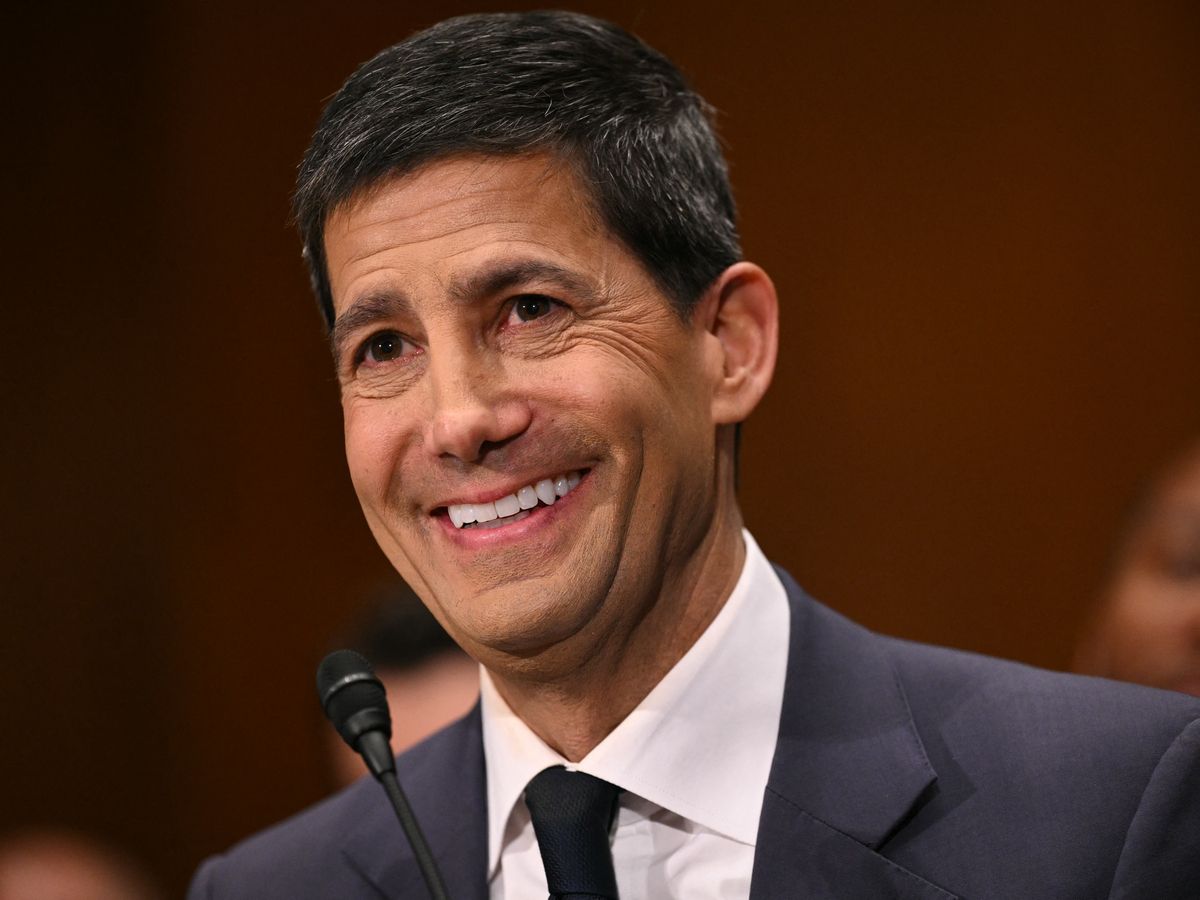
As Kevin Warsh steps into his new job as chair of the U.S. Federal Reserve this week, he’ll be heading up an institution dealing with stubborn inflation , pressure from U.S. President Donald Trump to cut interest rates and growing debate over how artificial intelligence is reshaping the economy. A former Wall Street banker, White House advisor and Fed governor, Warsh says he wants to bring a policy “regime change” to the central bank. Here, the Financial Post looks at his career, his views on Fed independence and what his appointment might mean to Canada.
Who is Kevin Warsh?
A graduate of Stanford University and Harvard Law School, Warsh started his career in investment banking at Morgan Stanley in the 1990s and held several key economic and financial advisory roles in the George W. Bush administration in the early 2000s.
At 35 years old, Warsh became the Fed’s youngest-ever governor when he joined the central bank in 2006. His background in finance came in handy during the 2008 financial crisis, connecting policymakers with Wall Street and helping the Fed interpret rapidly changing market conditions.
Warsh was considered an “inflation hawk” during his first stint at the Fed, focused on keeping inflation low and wary of aggressive rate cuts and the Fed’s quantitative easing policies.
After leaving the central bank in 2011, Warsh joined the Stanford Graduate School of Business as a lecturer and is a distinguished visiting fellow in economics at the Hoover Institution, a public policy think-tank at Stanford. He’s also a partner at the New York-based Duquesne Family Office, founded by famed billionaire investor Stanley Druckenmiller.
When Trump announced his pick for Fed chair on Jan. 30, the news wasn’t much of a surprise — Warsh has been on the president’s radar for nearly a decade. He was in the running to replace former chair Janet Yellen in 2017 (the job ultimately went to Jerome Powell) and was also reportedly considered by Trump for treasury secretary.
Warsh is married to Jane Lauder, a granddaughter of beauty mogul Estée Lauder who worked at her family’s company until 2024 and remains on its board of directors. Financial disclosure documents tied to his confirmation suggested Warsh had well in excess of US$100 million in assets, while Forbes lists his wife’s fortune at more than US$2 billion.
What is Warsh’s agenda for the Fed?
The 112-year-old Fed needs a policy “regime change,” Warsh said at his U.S. Senate confirmation hearing on April 21.
While hawkish in the past, Warsh has said recently that lower rates could be justified. In November, he argued in a Wall Street Journal op-ed that artificial intelligence will be a “significant disinflationary force” that boosts productivity. He also said inflation is a “choice” and happens “when government spends too much and prints too much.”
At his confirmation hearing, Warsh said one of the “essential elements” of new Fed policy will be to “get access to better data and to dig deeper into the productivity possibilities that can come out of this new investment wave.”
Warsh also the central bank needs a new framework for evaluating inflation and said he wants to “slowly and deliberatively” reduce the Fed’s balance sheet, which has grown from less than US$1 trillion in mid-2008 to US$6.7 trillion as of early May.
Reforming the century-old institution won’t be easy. The Fed’s open market committee that sets monetary policy isn’t a “one-man band” but a board of 12 voting members that makes decisions collectively, said Timothy Lane, former deputy governor of the Bank of Canada and senior fellow at the Centre for International Governance Innovation.
“The chair has a lot of influence automatically just by being chair, but that’s not enough by itself,” he said. “There’s a need to win over other people to his way of seeing things, and that’s something that could take a little bit of time.”
Where will Warsh go on rates?
Trump has repeatedly called for outgoing Fed chair Jerome Powell to keep interest rates low. When asked by a CNBC reporter in April if he would be “disappointed” if Warsh didn’t cut rates right away, Trump agreed that he would be.
Facing questioning from senators about pressures from Trump and the Fed’s independence, Warsh said he would be an “independent actor” if confirmed and said the president never asked him to “predetermine, commit, fix, decide on any interest rate decision in any of our discussions, nor would I ever agree to do so.”
The Fed’s next interest rate announcement is on June 17, and traders are pricing in a 98 per cent chance that the Fed will hold its target rate at 3.5 per cent to 3.75 per cent, according to the CME FedWatch tool.
“Almost any way they measure interest rate probabilities, there’s a very low chance of a cut anytime this year priced into the market at this point,” said Douglas Porter, chief economist at Bank of Montreal. “In fact, when you get into next year, the market is starting to price up rate hikes in 2027.”
Warsh’s first press conference after the June rate announcement will provide some “flavour” as to his intentions, said Paul Beaudry, former deputy governor of the Bank of Canada and professor at the Vancouver School of Economics at the University of British Columbia.
“His first speech after the decision will be quite revealing as to how he’s interpreting things, how he views things and what kind of messages he puts out,” said Beaudry.
What are Warsh’s connections to Mark Carney?
Warsh isn’t a stranger to Mark Carney . The two are professional acquaintances, as Warsh’s time at the Fed overlapped with Carney’s time as the governor of the Bank of Canada from 2008-2013.
When Carney was governor of the Bank of England in 2014, it hired Warsh to review its communications around interest rate decisions, with a view to improving transparency.
After Trump announced Warsh’s nomination in January, Carney said in a social media post Warsh is a “fantastic choice to lead the world’s most important central bank at this crucial time.”
Warsh has also worked with Bank of Canada governor Tiff Macklem , who took up the post in 2020 and was previously the central bank’s senior deputy governor from 2010-2014 and deputy governor from 2004-2007.
A Bank of Canada spokesperson said Macklem was unavailable for comment. When asked about Warsh’s nomination during a fireside chat at the Empire Club of Canada in Toronto on Feb. 5, Macklem said he welcomed it and noted that the two “worked closely” with then-chair Ben Bernanke during Warsh’s first stint at the Fed.
“Kevin is a very experienced central banker. He has deep knowledge of financial markets and the international monetary system,” Macklem said. “I am looking forward to working with Kevin as chair.”
What does Warsh’s appointment mean for Canada?
While the Fed and the Bank of Canada are separate entities in different countries with their own mandates, Beaudry said the two central banks have close ties and exchange information.
Because the two countries’ economies are highly integrated, Beaudry said it’s much easier when the Fed and Bank of Canada have similar goals and see problems the same way. He gave a hypothetical example of the Fed breaking from the two per cent inflation target it shares with Canada and raising it to three per cent.
“Where would things be difficult is if one country kind of follows a different policy from the other,” he said. “That’s certainly fine, there’s no problem with that idea, it’s just that the implementation of the transition could be difficult.”
If Warsh moves quickly to shrink the Fed’s balance sheet, Beaudry said it could create a “tension” that pushes up longer term interest rates in the U.S., which would also be felt in Canada.
“As we know in Canada, the real one that really matters for a lot of people is the five-year rate, given how mortgages are structured,” he said. “For businesses, 10-year rates are important also.”
Porter said the Bank of Canada will likely be watching with great interest to see if AI advances help boost productivity in the U.S. and whether that suppresses inflation.
He said it’s always good news for Canada when the American economy is doing well, and a productivity boom in the U.S. would could secondary benefits.
“I actually do believe that Canada could stand to benefit a bit ourselves from our productivity, from the AI built out,” he said. “I just think it will probably be a little bit more evident in the U.S. than in Canada.”
• Email: jswitzer@postmedia.com