At the height of protests in Iran this January, Mona Ghassani, the president of the Iranian Canadian Congress (ICC), was invited to speak on CBC.
Amid news reports estimating government forces had killed upwards of 20,000 civilians, Ghassani told host David Cochrane that the events unfolding in Iran did not “exist within a vacuum.” Ghassani blamed American sanctions, which had cratered the Iranian rial and Israel, particularly its intelligence agency — the Mossad — for conducting “influence operations” across the country and sowing discord.
“I want to emphasize that they have no interest in the Iranian people and they are only interested in their personal interests in the region,” Ghassani told the Canadian broadcaster.
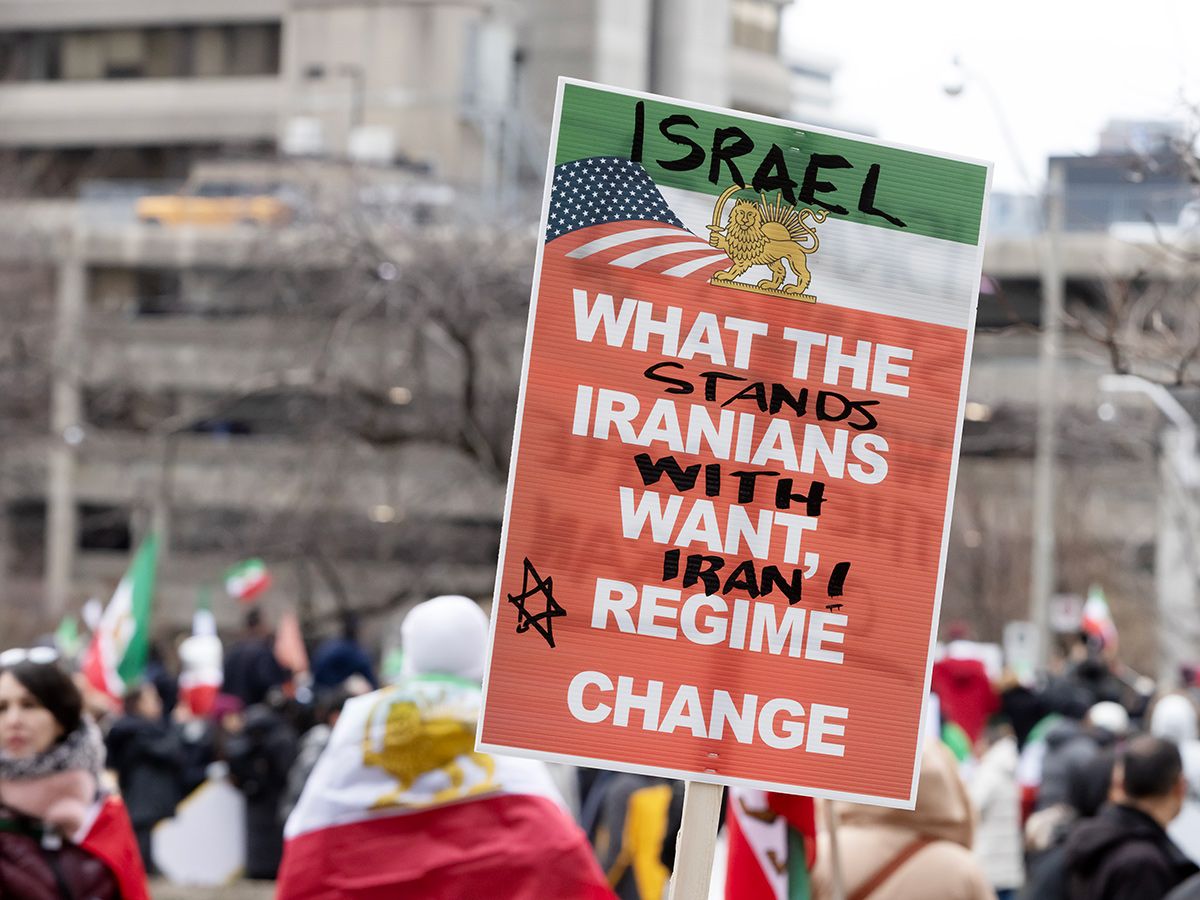
Ghassani’s remarks struck a discordant note on air, largely out of sync with the majority of Canada’s nearly 300,000-strong Iranian community. Most Iranian-Canadians see the Islamic Republic as a fundamentalist regime in need of toppling. A survey published by National Post in April found overwhelming support among Iranian Canadians for regime change and broad backing of the American-Israeli campaign to degrade the country’s military.
Throughout Ghassani’s appearance, there are odd pockets of silence and awkward transitions as they (Ghassani uses they/them pronouns) struggle to articulate how mainstream Iranian-Canadians feel about the crisis and where the ICC fits into the broader tapestry of the diaspora.
Ghassani comes off overly conscious of word choice, a tension reflected across the group’s Instagram page throughout the upheaval, which began in late December 2025. Not until Jan. 24, 2026, did the ICC release a generic message expressing “our condolences to the grieving families of the deceased among our compatriots in the recent unrest in Iran.” A similarly nondescript message, “wishing patience and peace for all survivors,” was published on Feb. 17.
But who killed them and why they were killed were left unanswered.
The CBC interview sparked an immediate backlash across the Iranian-Canadian community, highlighting the disconnect between the ICC and much of the community it ostensibly represents. The CBC even issued a rare apology for, as Cochrane said, unwittingly serving as “a platform for the narrative of the Iranian regime.”
Just days after Ghassani’s appearance, Cochrane invited Arsalan Kahnemuyipour, a University of Toronto linguistics professor, to speak about the ICC’s misrepresentation of widely held Iranian-Canadian beliefs. He dismissed Ghassani’s rhetoric as “offensive to the Iranian Canadian community” and said the ICC represented just a fraction of Iranian Canadians.
“I think they’re absolutely a fringe,” Kahnemuyipour told National Post. “They’re fringe in the Iranian Canadian community. They have much more support outside of the Iranian Canadian community.”
“Even with the support that they have from the non-Iranian community, go look at their rallies,” he continued. “If they dare have a rally, it would be maybe 50 people, 100 people outside of the U.S. embassy.”
Kahnemuyipour compared the small ICC public showings to the massive displays of support against the Iranian government witnessed in Ontario in February that drew an estimated 350,000 people into the streets.
“Our organization has consistently stood against the devastating realities of warfare, particularly emphasizing the catastrophic humanitarian consequences of military conflicts, such as the recent illegal U.S.-Israeli military actions against Iran,” the ICC told the Post in a statement. “The toll of these conflicts on innocent human lives is profoundly tragic.”
“The ICC actively works to raise awareness among Canadians regarding these severe impacts of war and the dangers of a ‘manufactured consent’ that paves the way for further military escalation,” the group continued.
The month after Ghassani’s interview, Iranian-Canadian activist Nazanin Afshin-Jam MacKay initiated a petition calling on the “House of Commons to conduct a comprehensive and independent review of the structure, governance practices, legal status, funding sources, and activities of the Iranian Canadian Congress.” Sponsored by Liberal MP Ali Ehsassi, the petition garnered over 13,000 signatures before it was closed in late March.
MacKay, an outspoken critic of the ICC for several years, preferred not to comment on the record for fear of potential legal action and pointed the Post to a series of tweets she wrote in recent years condemning the organization.
“The ‘Iranian Canadian Congress’ @ICCongress does not represent the voices of the Iranian Canadian community,” she wrote days after the Hamas atrocities on October 7. “Rather, they spew the same talking points and propaganda of the regime of the Islamic Republic.”

Alongside MacKay and Kahnemuyipour’s impression, a recent survey conducted by the Metropolis Institute, on behalf of the non-profit Advancement of Human Rights Organization for the Middle East, found the ICC represents just a sliver of Iranian Canadians.
The survey, conducted mostly at large Iranian community gatherings in major Canadian cities between late March and mid-April, found less than a third (31.4 per cent) of respondents were aware of the ICC before the survey, and barely above a tenth (11.2 per cent) of people agreed that the group “reflects the views of most Iranian Canadians.”
The Iranian Canadian Congress has long been saddled by questions of how representative the organization is. In late 2020, the Post reported on former Green Party candidate Dimitri Lascaris encouraging followers (many non-Iranian) that “any adult resident of Canada is eligible to join the ICC.”
Lascaris, a prominent anti-Israel activist with Greek ancestry, was interested in fending off candidates running for ICC leadership positions that he deemed to be “pro-sanctions and pro-regime-change elements on the right.”
That slate of candidates he opposed, which dubbed itself the “Change and Revival Campaign,” included Hamed Esmaeilion, an author and spokesman for the victims of Flight PS752 downing, former Ontario Liberal MPP Reza Moridi, and a founding leader of Quebec Solidaire, a provincial political party. Only one member of the group was eventually elected to the ICC’s board of directors at the time.
Arash Azizi, an Iranian academic at Yale University, supported the Change and Revival slate partly, as he wrote in December 2020, because ICC’s leadership “in recent years has been led by people who attack dissidents while remaining comparatively quiet about, say, the oppression of one of Iran’s largest religious minorities, the Baha’is.”
Lascaris attended Hezbollah leader Hassan Nasrallah’s funeral last February and rejects labeling Lebanese militia as a terror entity.
The ICC’s apparent embrace of the Islamic Republic’s foreign policy, and its projection of military power across the region have put off many in Canada. The ICC remains opposed to listing the Islamic Revolutionary Guards Corps (IRGC), a military organization in Iran, as a terror entity in Canada.
“What actually brought them to the spotlight was (that) they opposed the Canadian government’s decision to designate the IRGC a terrorist entity,” Farzad Hassani, an Iranian-Canadian dentist in Toronto and ICC critic, told the Post.
“I guess 50,000 people went to Richmond Hill,” Hassani continued, referring to a rally held in a Toronto suburb known for its large Iranian-Canadian community, in late February. “So 50,000 said, ‘We are against (the) IRGC,’ and these guys (the ICC) stand their ground. Obviously, you’re not a representative: at least for that 50,000.”
The sentiment extends across the country. Maryam Malekpour in Vancouver, B.C., knows well about the horrors of the IRGC.
In 2008, her brother, Saeed, an Iranian-Canadian from Victoria, B.C., was arrested by IRGC members for engaging in “un-Islamic” online activity while visiting their father in Iran. Saeed was jailed for over a decade in Evin prison, a facility with a notorious reputation for torture and the disappearance of political prisoners. Maryam advocated for her brother’s release throughout the ensuing years, even after Saeed received a death sentence. He eventually escaped back to Canada during a brief prison furlough in 2019.
“Many Iranian Canadians have direct personal experience with political repression, imprisonment, torture, discrimination, forced displacement, the execution of loved ones, or the loss of family members due to the actions of the regime,” Malekpour told the Post in a statement.
“As a result, many prioritize accountability, human rights, justice for victims, and support for democratic change,” she continued. “In my experience, the ICC has often appeared more focused on engagement and normalization than on accountability and justice. This has created a significant disconnect between the organization and many members of the community who have been directly affected by the regime’s actions.”
In its statement, the ICC described itself as a “strictly democratic organization” that builds policies based on members’ input.
“Central to the ICC’s core mission is an unwavering commitment to peace, diplomacy, and anti-war advocacy. Guided by the democratic mandate of our members, the ICC firmly opposes foreign military aggression, external interference, economic coercion, and unilateral sanctions,” the organization told the Post.
“We wish for Canadians to better understand the diverse perspectives within the diaspora and to recognize the importance of amplifying voices that advocate for peace, dialogue, and humanitarian protection over pro-war rhetoric.”
There remains a growing hunger among many Iranian-Canadians to build new, alternate institutions that they say would better resemble the community.
“The ICC has not meaningfully evolved to reflect the community,” Hudson Mahboubi, an Iranian-Canadian in Toronto, wrote the Post.
(Maryam Malekpour and Mahboubi were both involved in distributing the Metropolis Institute survey to gauge the views of Iranian-Canadians.)
Mahboubi is part of a growing wave of Iranian-Canadians conducting informal conversations with the Canadian Jewish community to explore the potential of creating a federation model.
“If anything, (the ICC) has become more isolated as the Iranian-Canadian diaspora has grown more unified in its rejection of the regime. There may have been a period when it presented itself as a broad civic organization, but its consistent pattern of softening criticism of the Islamic Republic, opposing robust pressure on the regime, and aligning with anti-Israel positions has long placed it outside the mainstream,” Mahboubi said.
“The 2026 survey confirms what many activists have observed for years: the ICC does not speak for the community it claims to represent.”
National Post
Our website is the place for the latest breaking news, exclusive scoops, longreads and provocative commentary. Please bookmark nationalpost.com and sign up for our newsletters here.