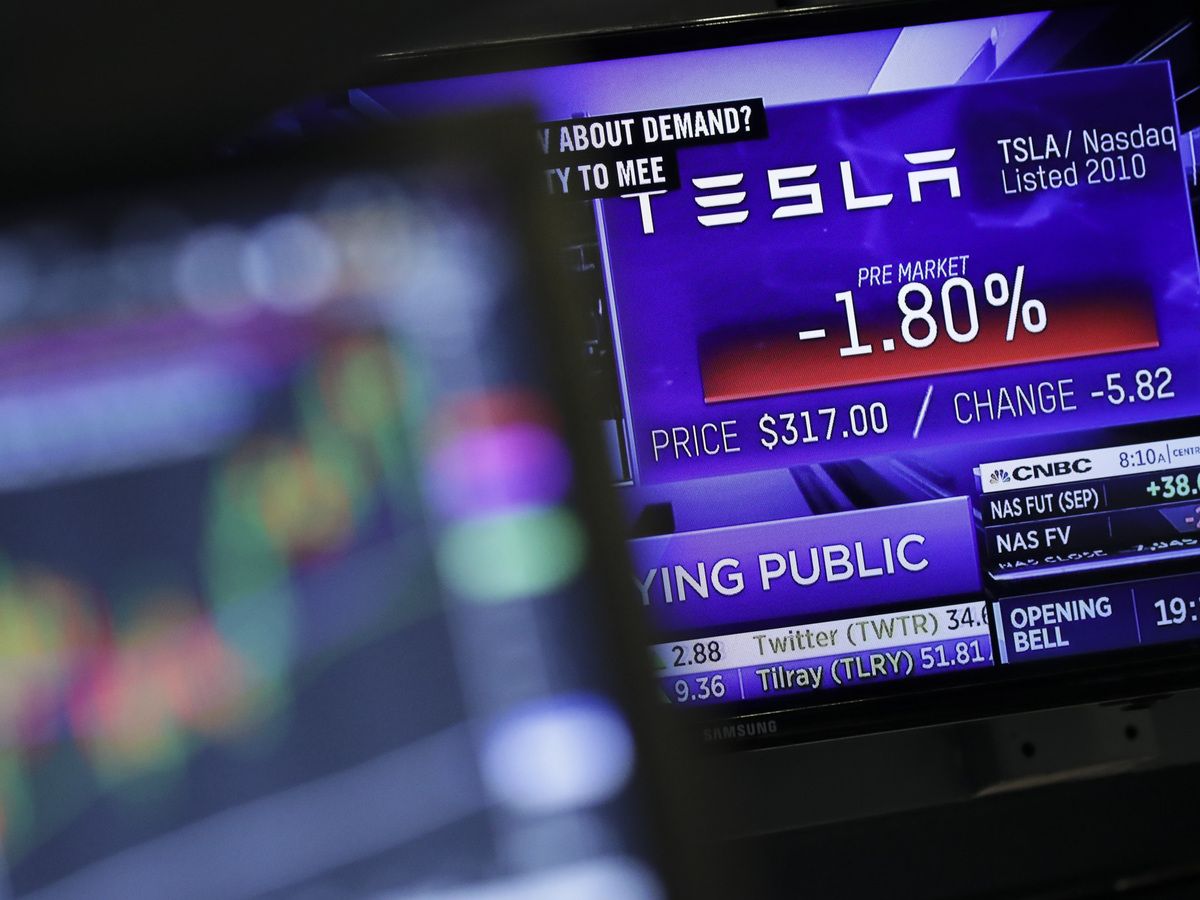
It’s been a challenging year for Tesla Inc. shareholders, losing 14 per cent while watching Elon Musk ’s SpaceX complete the biggest initial public offering ever and immediately become the most valuable entity in the newly minted trillionaire’s collection.
But Space Exploration Technologies Corp.’s IPO last week is also providing hope for Tesla investors, who are betting that Musk will ultimately engineer a merger of his two businesses. And should SpaceX’s stock continue its recent slump, some analysts predict it will only make Tesla shareholders more agreeable to the idea. The combination would create a massive technology conglomerate that could eventually join Nvidia Corp., Alphabet Inc. and Apple Inc. as one of the world’s biggest companies.
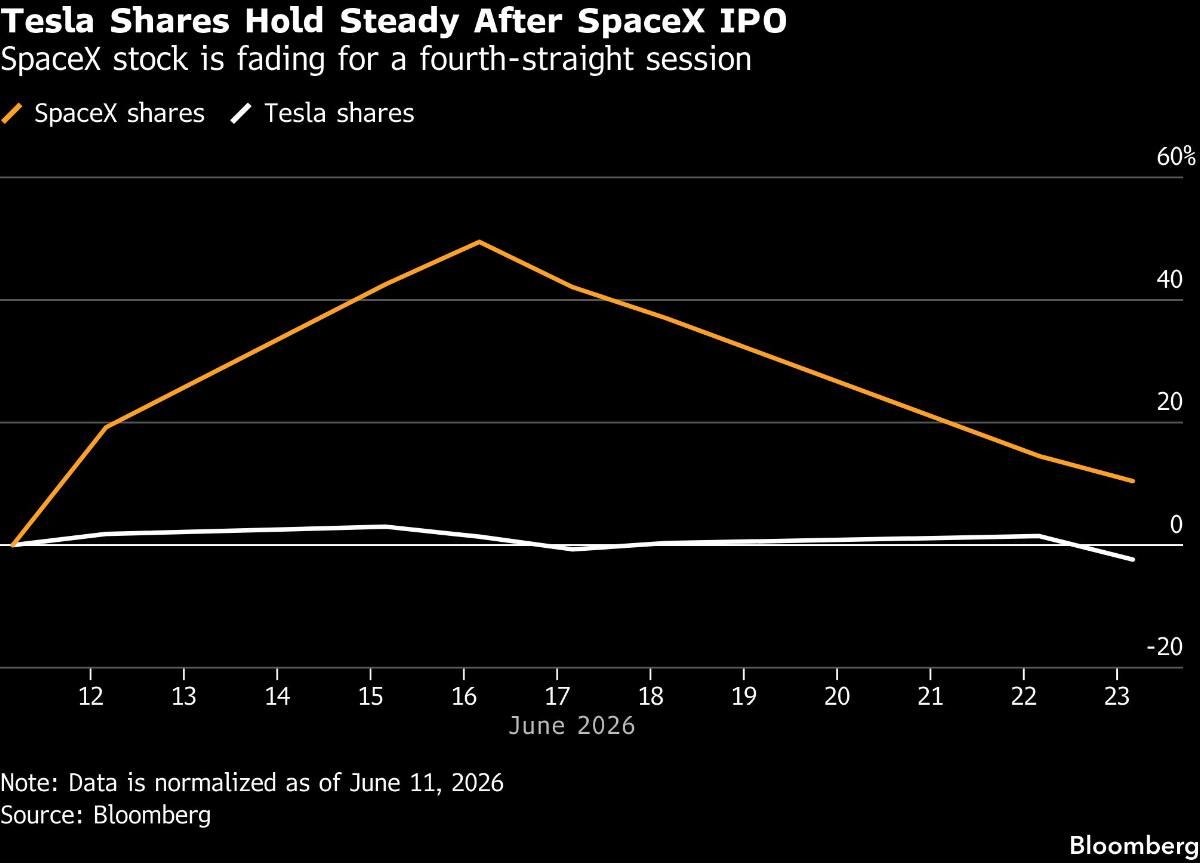
That optimism from Wall Street may help explain why Tesla shares have held fairly firm since the IPO and climbed back over US$400 on Monday, even as SpaceX sees the post-IPO euphoria evaporating.
Ivan Feinseth, chief investment officer at Tigress Financial Partners, sees the IPO as a “narrative catalyst” for Tesla. Dave Mazza, chief executive officer of Roundhill Financial, which owns Tesla shares, is more convinced of a potential merger now than before SpaceX went public.
“For years, Tesla was the only public way to own the Musk premium, and now it is not, with SpaceX as the cleaner expression of the AI and space story,” Mazza said. “What is holding Tesla above US$400 is an acquisition premium building in.”
Although they’re both owned by Musk, the two businesses aren’t an obvious fit. Tesla operates one of the most successful electric-vehicle businesses in the world and is expanding into autonomous driving and building a humanoid robot called Optimus. SpaceX manufactures and launches rockets and satellites and has ambitions to send a man to Mars.
AI combination
Where the companies dovetail is in artificial intelligence — and the extensive amount of cash needed to fund its development. SpaceX absorbed xAI, parent of the Grok chatbot and the social media site formerly known as Twitter, in February. Now, it’s embarking on a semiconductor manufacturing joint venture with Tesla dubbed the Terafab. And further endeavors are likely to require more capital than either outfit has on its own.
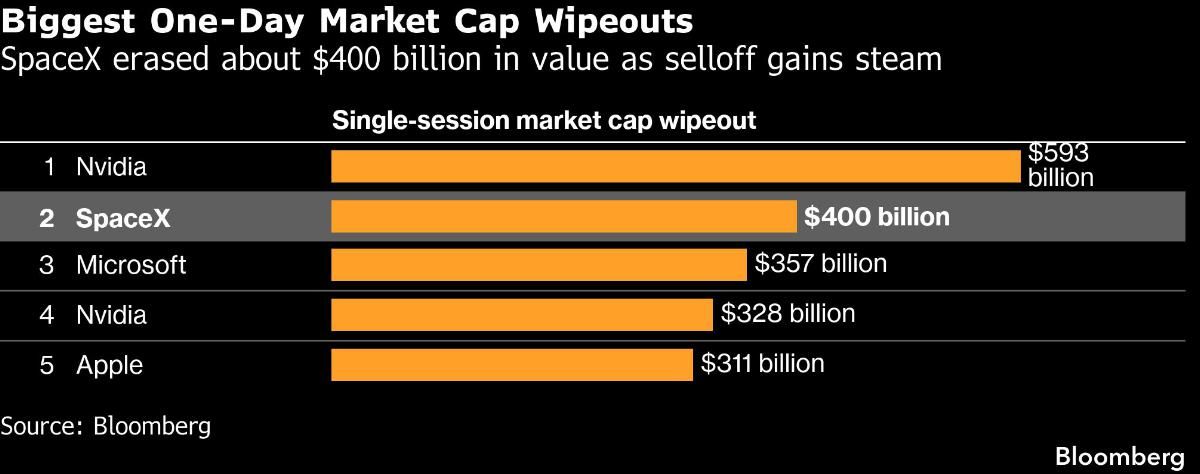
Of course, the challenge in any deal is the price, and in this case that’s even more difficult because of the volatility in SpaceX’s stock. Tesla’s market capitalization is roughly US$1.5 trillion, while SpaceX was around US$2 trillion as of Monday’s close, down from US$2.6 trillion a week ago. But SpaceX’s valuation was closer to US$400 billion just a year ago, and the February xAI deal priced it at around US$1 trillion with the AI business valued at around US$250 billion, Morningstar analyst Seth Goldstein wrote in a research note on July 9, before the IPO.
“With SpaceX’s soaring valuation leading up to its IPO, we doubt Tesla shareholders would want to buy SpaceX while its valuation multiples are far higher than theirs,” Goldstein wrote. Meanwhile, SpaceX shareholders are unlikely to accept a steep discount but would likely be more amenable if the stock retreated closer to Morningstar’s fair value estimate of US$63, he wrote. The shares went public at US$135 and opened at US$151.06 Tuesday.
That said, Goldstein added that “we wouldn’t be surprised to see a deal occur within a year” since Musk’s companies tend to move quickly.
Wedbush analyst Dan Ives sees a greater than 80 per cent chance that SpaceX and Tesla merge next year. On the other hand, Timothy Horan, SpaceX analyst at Oppenheimer, expects to see a combination eventually but isn’t convinced Musk is in a rush. Betting site Polymarket shows 39 per cent probability of a deal getting done by the end of December.
Since a potential merger wasn’t discussed in SpaceX’s S-1 IPO registration filing, it isn’t likely to happen before next June, according to Nicholas Colas, co-founder of DataTrek Research. In addition, it doesn’t make sense to do right away considering SpaceX went public to amass cash and Tesla doesn’t generate that much itself, he added.
“It doesn’t mean that you can’t carry an acquisition premium in Tesla for as long as that possibility is out there, but I don’t see it as a near-term event,” Colas said.
Retail darlings
Musk’s companies stand out, in part, because of the large cadre of ordinary investors who buy the stock. Retail cash has poured into SpaceX since its debut and shunned Tesla, according to data from Vanda Research and AJ Bell.
Take Glenn Reisender, a 71-year-old retail trader from Long Island who never owned Tesla but ordered 100 shares of SpaceX and received 55. He’ll buy more if a merger is announced.
“I think the merger would be great for both,” he said. “It would be a way to consolidate and make both stronger.”
On the other side is Alexandra Merz, a prominent Tesla trader behind the @TeslaBoomerMama X account, who told Bloomberg Television that she eschewed buying SpaceX shares because she thinks a deal will go through by next year.
Stephen Levy, a 27-year-old full-time retail investor in Chicago only ordered five shares of SpaceX before the IPO because he favors smaller-cap stocks but wanted to be a part of the action. However, a combination of SpaceX and Tesla would trigger “an entire reassessment in my mind.”
“That’s the endgame of the thing you want to invest in,” he said.
Of course, the downside of all this speculation is that if a merger doesn’t go through, Tesla shareholders could take a hit, at least in the short term.
“No deal means no shortcut for Tesla,” Roundhill’s Mazza said. “With SpaceX now a standalone way to own the Musk premium, Tesla can no longer borrow that excitement, and it has to deliver on Robotaxi and Optimus to justify where it trades.”
With assistance from Subrat Patnaik, David Watkins and Rheaa Rao