
Canada’s dismal productivity that has significantly lagged other OECD countries over the past few decades is a common complaint, but fixing it won’t come cheap, according to a leading economist.
Charles St-Arnaud, a former strategist at the Bank of Canada , says the main culprit for this underperformance has been a lack of investment in the economy. Remedying that will take an outlay he describes as “staggering.”
Decades of underinvestment have resulted in Canada’s stock of capital per worker (buildings, machinery and intellectual property used in production) falling severely behind its advanced nation peers, said St-Arnaud, who is now chief economist at Servus Credit Union.
How bad is it? Here are a few sobering statistics:
- The stock of capital per worker of the OECD’s 10 most productive countries is 50 per cent higher than in Canada on average. At the top end, Switzerland’s is 118 per cent higher than Canada’s.
- Since the oil bust of 2015 Canada’s stock of capital per worker has increased just 0.2 per cent a year on average, compared to 1.2 per cent in the more productive countries.
- The result is that these countries’ productivity is 37 per cent higher than Canada’s and their GDP per capita is 31 per cent higher on average.
To catch up to the productivity level of these nations, Canada’s stock of capital needs to grow by up to 5.4 per cent per year over the next decade which would require an investment of $7.6 trillion.
Closing half that gap would require Canada’s capital stock per worker to grow by up to 3.5 per cent annually, an investment of up to $4.5 trillion.
Just to prevent the gap between Canada and its peers from widening would take an investment of up to $2.2 trillion.
“Putting these numbers in context, the economy requires about $1 trillion in investment per year, the equivalent of about 30 per cent of GDP, over the next 10 years just to ensure we do not see further decline in competitiveness relative to the leaders in the OECD,” said St-Arnaud.
Doing nothing doesn’t seem an option, because if Canada’s pace of capital investment doesn’t pick up, the gap between it and its OECD peers will widen to over 60 per cent in 10 years.
The elephant in the room is how to pay for it.
St-Arnaud’s report also considers the costs of fixing Canada’s housing affordability crisis which over the next 10 years could take an extra $1.7 trillion above and beyond what would normally be spent on home construction. Add the two “generational challenges” together and the total nears $9 trillion.
Most of the heavy lifting will fall to foreign investors.
However, St-Arnaud warns that relying on money from abroad runs the risk of Canada becoming even more of an “extractive” economy where profits flow out of the country and are not invested domestically. Attracting capital may also require higher interest rates, which brings its own set of problems.
Policy makers can help with incentives to direct more domestic savings from pension funds, asset managers and households into Canadian projects, he said. The financial system could also be adjusted to channel more lending toward productive business investment rather than household borrowing.
“What is clear is that there is no cheap or easy path out of Canada’s current predicament. The country’s ambitions for housing affordability and competitiveness are within reach, but only with a scale of investment, saving, and structural adjustment that Canada has not mustered in decades,” said St-Arnaud.
“Falling short of that ambition will mean accepting that the country will keep falling further behind.”
Sign up here to get Posthaste delivered straight to your inbox.

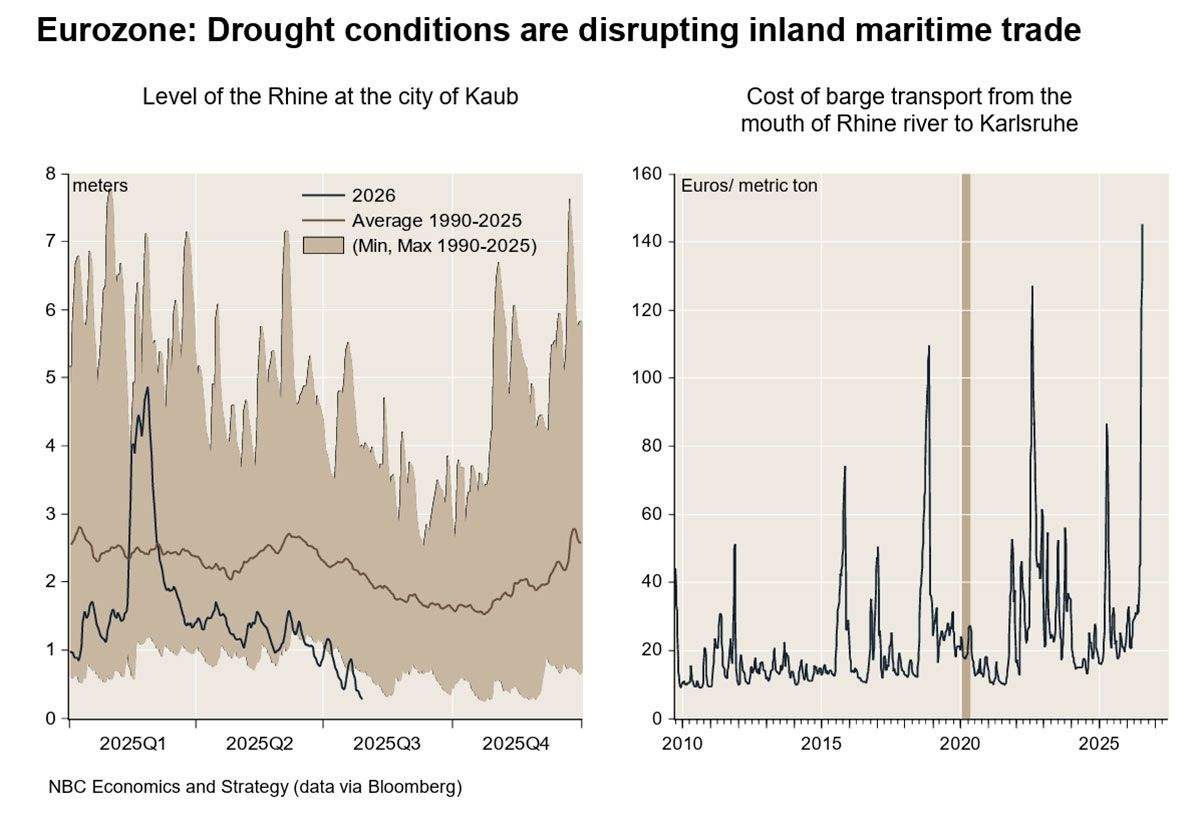
The drought that has wreaked havoc on Europe with the worst wildfires in living memory is also disrupting supply chains, writes National Bank of Canada economist Jocelyn Paquet.
The lack of rainfall and high temperatures this summer have “effectively dried up” the Rhine River, through which about 7,000 merchant ships normally pass each day.
As Paquet’s chart shows, the water level at the Kaub chokepoint in the river fell to 28 centimetres this week, the lowest ever recorded at this time of year.
This has forced ships to either limit how much they carry or halt operations through the waterway altogether, pushing the price of barge transport to a historic high.
It doesn’t help that the barges run on diesel, the price of which has soared during the Iran war.

- Today’s Data: United States GDP, personal income and spending
- Earnings: Bombardier Inc., Loblaw Cos Ltd., Hershey Co.


- Investors wondering when the stock market party will end caught between rock of FOMO and hard place of fear
- Allied Gold’s $5.5 billion sale to Chinese gold miner falls apart amid slide in gold prices
- Why forcing landlords to pay for air conditioning upgrades could backfire

With the current bull market now into its fourth year, many investors are wondering when the party will end. They are trapped between the “rock” of FOMO (fear of missing out) and the “hard place” of FOL (fear of losses). Investing columnist Noah Solomon looks at the 13 bear markets since the postwar era to see how they compare to today. Read more
 Interested in energy? The subscriber-only FP West: Energy Insider newsletter brings you exclusive reporting and in-depth analysis on one of the country’s most important sectors. Sign up here.
McLister on mortgages
Want to learn more about mortgages? Mortgage strategist Robert McLister’s Financial Post column can help navigate the complex sector, from the latest trends to financing opportunities you won’t want to miss. Plus check his mortgage rate page for Canada’s lowest national mortgage rates, updated daily.
Financial Post on YouTube
Visit the Financial Post’s YouTube channel for interviews with Canada’s leading experts in business, economics, housing, the energy sector and more.
Today’s Posthaste was written by Pamela Heaven with additional reporting from Financial Post staff and Bloomberg.
Have a story idea, pitch, embargoed report, or a suggestion for this newsletter? Email us at posthaste@postmedia.com .
Bookmark our website and support our journalism: Don’t miss the business news you need to know — add financialpost.com to your bookmarks and sign up for our newsletters here