
Airbnb Inc. shares jumped by the most in 16 months after the company boosted its annual revenue forecast for a second time this year, citing robust demand in the United States and Europe.
The short-term rental company said Thursday that it now sees annual revenue growth improving by a percentage of “at least mid teens” from the prior “low- to mid-teens” guidance it provided in May. Analysts, on average, expected a 14 per cent jump, according to data compiled by Bloomberg. Airbnb also boosted its full-year margin forecast for adjusted earnings before interest, taxes, depreciation and amortization to “at least 35.5 per cent” from at least 35 per cent.
“The uplift in revenue growth and margin reflects the strong demand on our platform, benefits from investments we’ve made in talent, technology and marketing as well as strong execution across our product road map,” the company said in a letter to shareholders.
The shares climbed as much as 14 per cent to US$173.34 on Friday after trading got underway in New York, their biggest intraday gain since April 9, 2025.
Airbnb’s optimistic outlook suggests that travel demand remains healthy . The company, a pioneer in letting hosts rent out their homes , has been working to reimagine itself as an all-in-one platform that also offers hotels, tours, local activities and add-on services such as grocery stocking and in-home beauty appointments. Travel peers Expedia Group Inc. and Booking Holdings Inc. also signalled confidence in the travel market when they posted their latest earnings reports this week.
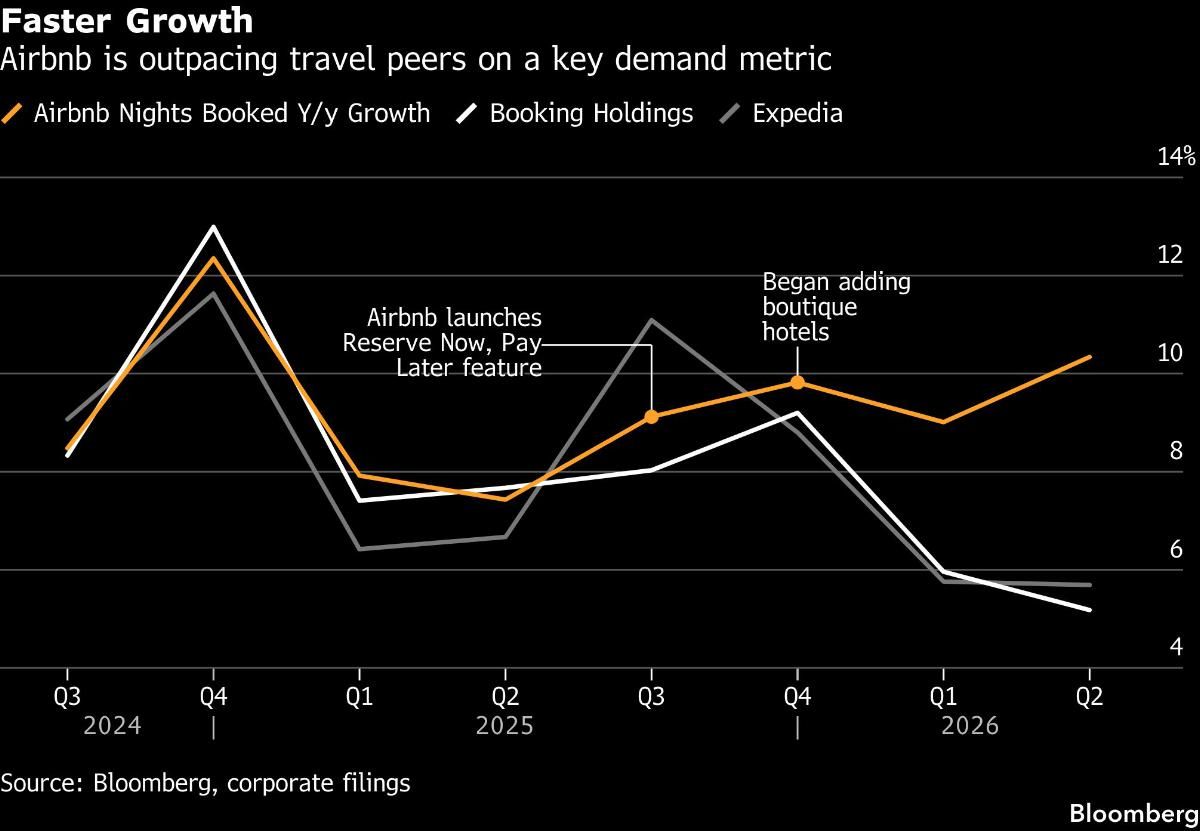
In the second quarter, overall nights and seats booked jumped 10 per cent to 148.3 million, topping analyst estimates. North America saw the highest growth in nearly three years, Airbnb said, adding that other core markets like France, the United Kingdom and Australia also grew at a faster pace.
The company is projecting that the momentum will continue in the third quarter. The key metric of nights and seats booked will grow in the low double digits, ahead of the 8.2 per cent gain that Wall Street was expecting.
Airbnb has been offering rooms at boutique hotels in markets where short-term rentals are tightly regulated since late last year. Chief executive Brian Chesky told analysts on a call Thursday that the push has since expanded more broadly to cities that aren’t necessarily restricted, as it has proven popular and effective in converting some hotel bookers into returning customers who also rent homes.
Airbnb now has thousands of these hotels in more than 20 destinations, including New York, Paris, London, Madrid, Rome and Singapore, it said in the statement. As part of its nascent services business, Airbnb has also begun selling resort passes to give guests access to amenities at hotels, it said.
Hotels still represent a single-digit percentage of nights booked, it said, but growth has far outpaced its core homes business by about three times.
Upcoming AI Features
Later this year, Airbnb will begin rolling out new in-app features involving artificial intelligence and personalization, Chesky said on the earnings call.
Those include a home comparison tool available to guests before making a reservation, as well as AI voice customer support on phone calls, he said. The company’s text-based AI support agent, which is available in more than 50 languages, has already helped reduce support costs per booking by about 16 per cent from a year ago, he said.
The company will also start testing a new AI search toggle on the homepage this month, Chesky added.
The new search will allow natural-language input and respond conversationally, similar to a chatbot experience, while also including visual elements of home listings with personalized, AI-generated titles.
Chesky said responses from the AI search are “hopefully less chatty” with “fewer words because we think travel is more visual, very, very personalized.” He added that he hopes the experience will result in “much higher conversion rates.”
The traditional search box that customers are familiar with will still be the default user experience, according to Chesky. “We don’t want to impose that on everyone,” he said of AI search. “It’s going to take some time, months and months to retrain the customer.”