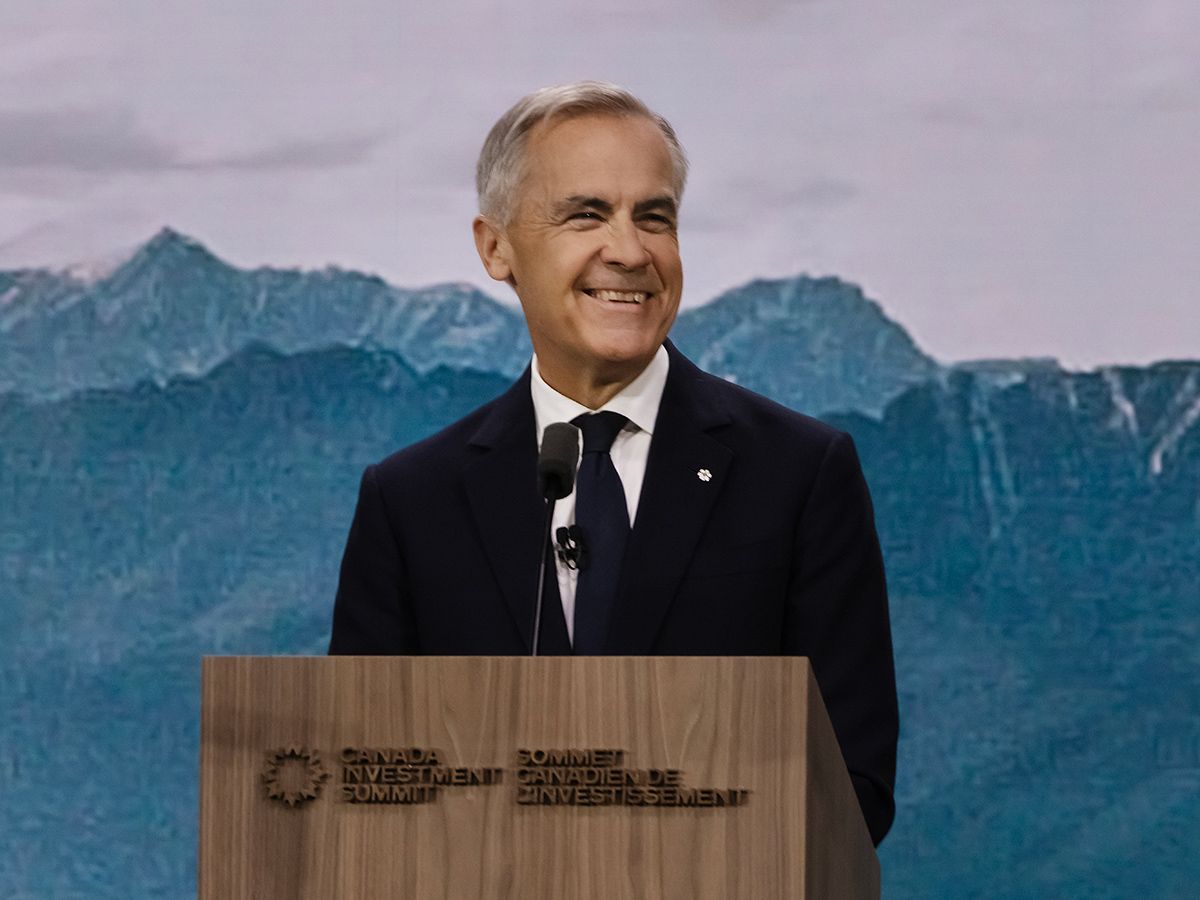
Nearly $500 billion in new investment has been committed at the Canada Investment Summit as the federal government said it is seeking private investments for the country’s airports, making major tax-related announcements and making changes that may speed up the permitting processes for key economic projects.
Prime Minister Mark Carney kicked the day off by announcing that Canada will seek financing to operate the country’s four biggest airports — Toronto Pearson, Vancouver International, Montreal Pierre Elliott Trudeau International and Calgary International — and use the capital raised to reinvest in other priorities.
“Canadian pension funds already invest successfully in many airports around the world. It is time to bring that same expertise home to more directly benefit all Canadians,” he said.
Ottawa also made a major tax announcement on expanding a tax write-off program for capital investment, cutting one of Canada’s tax rates to among the lowest in the world.
In the last budget, the government introduced a “productivity super-deduction” so that businesses can immediately deduct 100 per cent of the cost of eligible new investments, such as machinery, equipment, and technology.
Carney said this tax incentive will now be increased to more than 65 per cent of assets, including fibre-optic cable, mining property and oil and gas pipelines, from roughly 15 per cent.
As a result, the marginal effective tax rate on new business investment will fall to 6.4 per cent from roughly 13 per cent, which the government said it makes it the lowest of any major economy in the world and less than half the rate in the United States.
Royal Bank of Canada chief executive Dave McKay said the move was very consequential.
“I feel a renewed interest in Canada for sure,” he said at the summit. “The feedback I’m hearing is there’s a consistency of message between the prime minister and his team, the premiers and their teams and CEOs. We’re pulling in the same direction. That hasn’t happened in a long time. We just have to get it done now and, as you heard, time kills deals.”
Carney said Ottawa will look to make legislative changes to speed up reviews of potential projects, like it has done for the roughly two dozen projects under the Major Projects Office.
“We’re now going to apply the same urgency and efficiency focus more broadly through the New Build Canada Strong Act, for projects and supply, our standard will be simple: one project, one review, one year,” he said at a press conference.
Jonathan Price, chief executive of Teck Resources Ltd., said he welcomed Carney’s comments and said the government has been more pragmatic when it comes to approving key projects in Canada.
“It’s really the mindset of government that has changed here,” he said at a separate event at the summit.
Despite the planned cut in approval times. Price said the miner won’t take any shortcuts and will ensure the environment is not impacted because of its projects.
“We have to get the social aspects of this right, including the relationships with First Nations, and that takes time,” he said. “But what this government is now giving us is a predictable framework that we can work through.”
Price said there was no real idea as to when a decision regarding a project was going to be taken in the past, but there are now fixed timelines and one can understand the process.
Among the other announcements at the summit, Toronto-based Radical Ventures Investments Inc. announced the first close of its Radical Breakouts Fund, touted as the largest-ever venture-capital fund in Canadian history, with more than US$1 billion in commitments raised so far to support AI scale-ups.
The Canada Pension Plan Investment Board (CPPIB) and Brookfield Asset Management Ltd. announced a new $50-billion Maple Fund for large-scale investments in Canada, including funding for critical infrastructure and strategic industries.
“All told, this summit is laying the foundation for enormous new investment and strategic partnerships, accelerating transactions, deals already in motion,” Carney said. “We have seen it happen before. Conversation turns into commitment. Commitment turns into investment.”
CPPIB chief executive John Graham said the summit is not a victory lap, but a working session, whose value will be measured by what comes next.
Larry Fink, chief executive of BlackRock Inc., the world’s largest asset manager, said he has believed in Canada for 20 years and though it’s a destination his firm has thought of as a place to invest, it has historically had difficulty finding investment opportunities.
“I do believe what has been announced the last two days is going to be opening up the opportunities to bring forth more capital to Canada,” he said, referring to Tuesday’s announcement that Canada will open its four largest airports to private capital investment.
Carney also shared his view that the world is becoming more divided and dangerous, with economic integration being weaponized and tariffs being used as leverage.
In such a situation, “first, we must take care of ourselves,” he said, and that means building strength at home and diversifying trade partnerships abroad.
“We are unleashing our full potential as an energy superpower,” he said.
Canadian businesses now enjoy tariff-free access to 1.5 billion consumers, Carney said, and Ottawa intends to double that through new trade deals from the Association of Southeast Asian Nations to India over the next six months.
He also had a message for the United States.
“We will always be neighbours and Canada will continue to be the U.S.’s most important partner in many key areas,” he said. “After all, even at times of disagreement during our long history, we have always maintained deep ties.”
But Carney said these arrangements will only work when “we engage as true partners that respect each other’s traditions and sovereignty.”
nkarim@postmedia.com