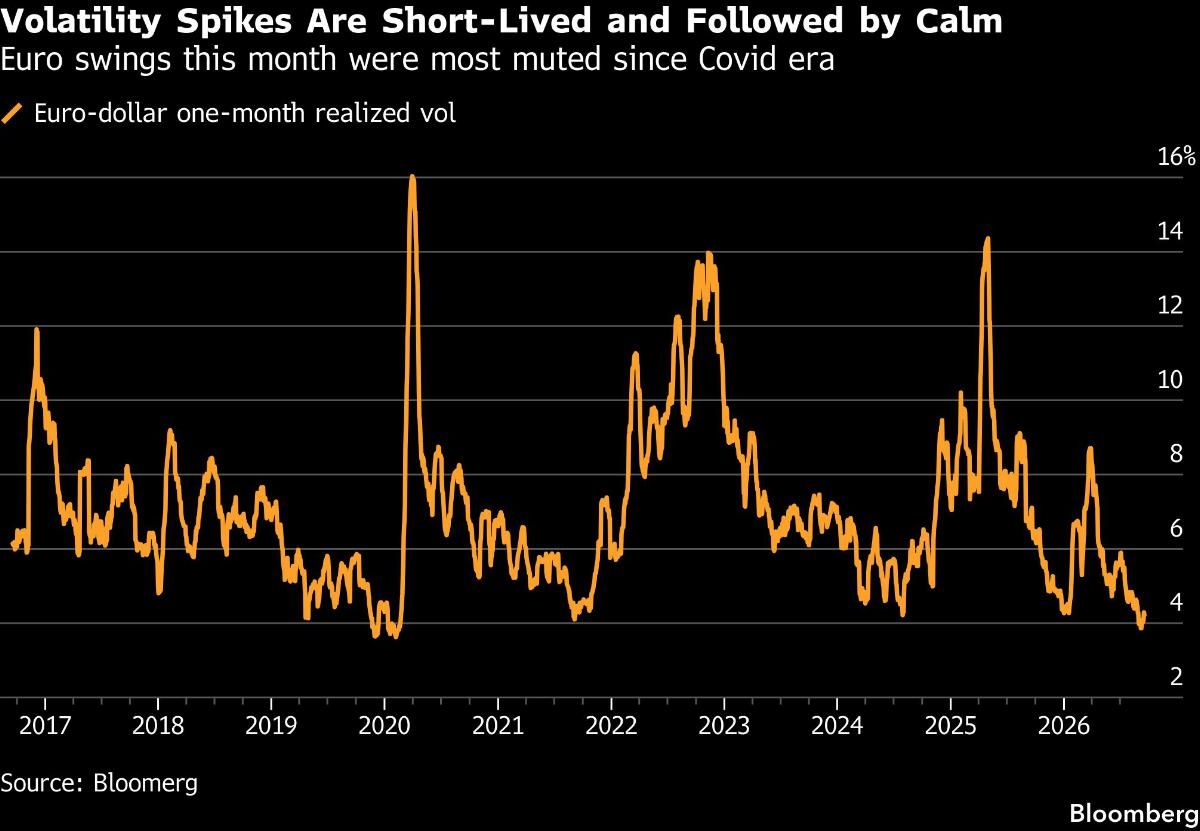
Currency volatility has been so low for so long that traders are starting to treat it as the new normal rather than a passing phase.
That subdued backdrop was among the major themes at an annual industry gathering in Amsterdam this week for a second year running, with investors describing a market where sharp changes in bonds, oil and geopolitics still struggle to generate lasting currency swings .
“What we are lamenting is a secular downtrend in currency volatility,” said Harish Neelakandan, co-chief investment officer at AlphaEngine Global Investment Solutions, a systematic trend-following fund. “That’s the hand we’ve been dealt. We have to learn to live with this.”
This lack of volatility in the US$9.6 trillion-a-day foreign-exchange market is becoming a perennial problem for traders aiming to thrive on big swings. Yet the calmer environment is likely to be beneficial for asset managers and companies looking to hedge their exposure.
Neelakandan said greater coordination between central banks has helped contain currency moves, leaving geopolitical shocks to produce only brief bursts of volatility. Unless that backdrop changes fundamentally, traders are likely to keep treating such spikes as opportunities to short volatility once again.
“What we’re seeing is the ‘nothing ever happens’ trade, where people just keep selling volatility,” said Thomas Carreau, a currency portfolio manager at CN Investment Division, which manages Canadian National Railway ’s pension fund .
Even recent yen moves have remained relatively contained, Carreau said. The currency has been in the spotlight in recent months after sliding to the weakest in four decades before joint United States-Japanese intervention to support it caused a series of sharp rallies.
He added that carry trades, where investors borrow in low-yielding currencies to buy higher-yield assets, continue to perform well. He prefers to structure them to be dollar neutral because U.S. President’s Donald Trump’s social media posts can still cause small day-to-day swings in the U.S. currency. It’s a strategy that performs well when volatility is low.
“Carry is king,” he said.
Time Bomb
The prolonged calm does pose some risk. Harel Jacobson, associate portfolio manager at hedge fund Capstone Investment Advisors, said lower volatility forces traders to put on larger positions to generate the same returns, leaving portfolios more exposed when a rare big move hits.
“What you end up with is a ticking time bomb sitting on your portfolio,” said Jacobson. His fund routinely buys cheap hedges designed to protect against unusually large market moves, pointing to last year’s surge in the Taiwan dollar as the kind of event they are looking to cover.
Low volatility isn’t necessarily bad news for everyone. It can also reflect a liquid and efficient market that continues to absorb shocks in a volatile world.
“The world might not be reliable, but the FX market is,” said the conference chair Allan Guild, director of Hilltop Walk Consulting.
Adapting
Companies are adapting their strategies. Georgios Velissariou, head of financial risk management at Hitachi Energy’s group treasury, said lower volatility had made options a more attractive way to hedge certain currency exposures.
Meanwhile for some banks, the environment is prompting a rethink of parts of their operations. Karel Sanders, head of FX product management at Rand Merchant Bank, said dollar-rand volatility at a two-decade low was forcing the South African lender to reconsider how it runs its options business.
“Do we stay principal market makers in FX volatility, or do we become an agency business? We’re leaning more towards an agency business,” he said.
There were also signs on the conference floor that traders were looking beyond traditional FX for action. At one stand, attendees were tempted by sweet Dutch waffles to vote on which currency pair would move the most over the main day. The winner was silver against the dollar.
A market increasingly built around low volatility may be poorly protected on the rare occasions when that calm breaks. Some see little incentive to prepare.
“The market finds itself in a situation where we don’t know what the catalyst will be for the next blow up and no one is positioned for it, because if you’re early you’re wrong,” said Carreau.
—With assistance from Vassilis Karamanis.