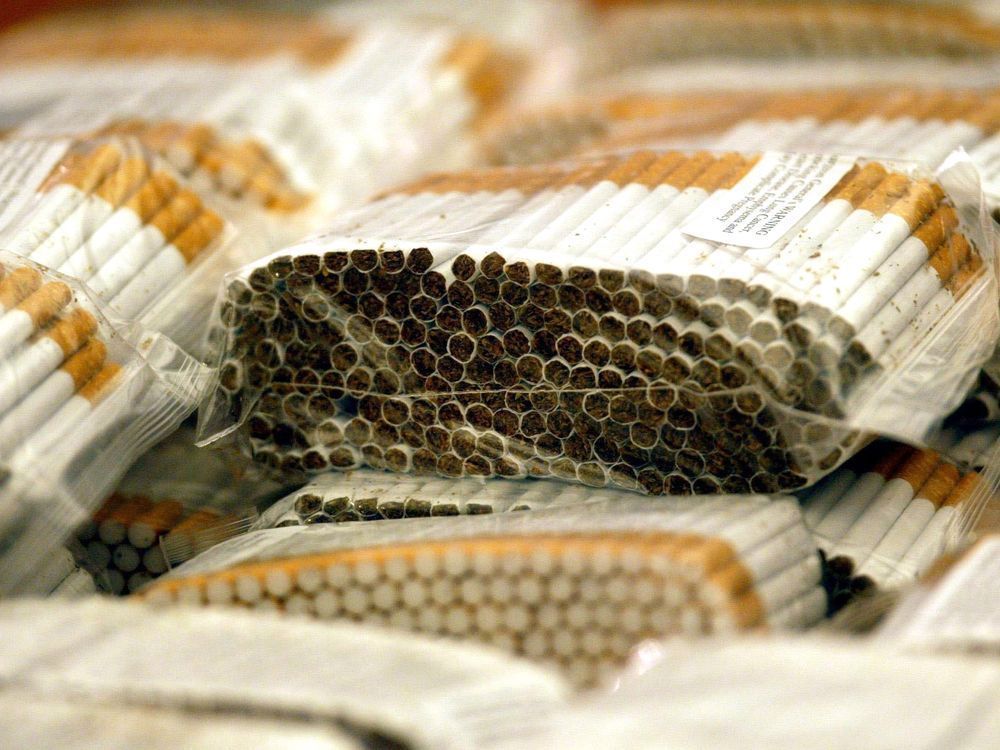
The Hells Angels and other organized crime groups are increasingly involved in the lucrative black market cigarette business.
The revelation comes after two recent seizures of illegal cigarettes and nicotine vapes in Southwestern Ontario.
Police identified 173 organized crime groups – including the mafia, the Hells Angels, the Outlaws and their support clubs – involved in black market tobacco, said Rick Barnum, chief executive of the National Coalition Against Contraband Tobacco.
“These are major crime groups,” he said. “They’re making contraband tobacco more of a mainstay in their staple of illicit products that they sell and traffic.”
With an estimated 50 per cent of Ontario smokers using contraband products, organized criminals have moved in to capture the market as the price for illicit products increases, said Barnum, a former OPP deputy commissioner who retired in 2019.
“It’s a multi-billion-dollar business for organized crime now to sell contraband cigarettes,” he said.
Created in 2008, the National Coalition Against Contraband Tobacco works with businesses, law enforcement and governments to combat black market tobacco products and educate the public.
The OPP’s contraband tobacco enforcement team made seizures it valued at $18.7 million in 2024, up from $1.5 million the previous year. That represents an estimated $39 million in lost tax revenue, according to an OPP report.
Last month, the Canada Border Services Agency seized illegal tobacco and nicotine vapes valued at about $4.5 million over seven days coming from the U.S. at the Blue Water Bridge, near Sarnia.
On Mach 25, two people were charged after the
OPP seized about 22,000 unmarked cigarettes
in Central Elgin on a traffic stop.

A carton of legal cigarettes costs about $147, compared to $42 on the black market. The products are sold in Indigenous communities and online, Barnum said. “People just can’t afford to smoke. So they’re switching to contraband.”
Criminals have set up illegal tobacco factories in Indigenous communities in Kahnawake, Que., southwest of Montreal, and Six Nations of the Grand River near Brantford, Barnum said.
“It’s not necessarily an Indigenous community thing,” he said. “It’s the fact that a few bad actors in those communities have welcomed in organized crime and now they’re in there.”
An RCMP report says illegal tobacco undermines “global and domestic health objectives,” contributes to the proliferation of organized crime, invites criminals into communities, undermines the legitimate economy and evades “taxes that support Canada’s social programs.”