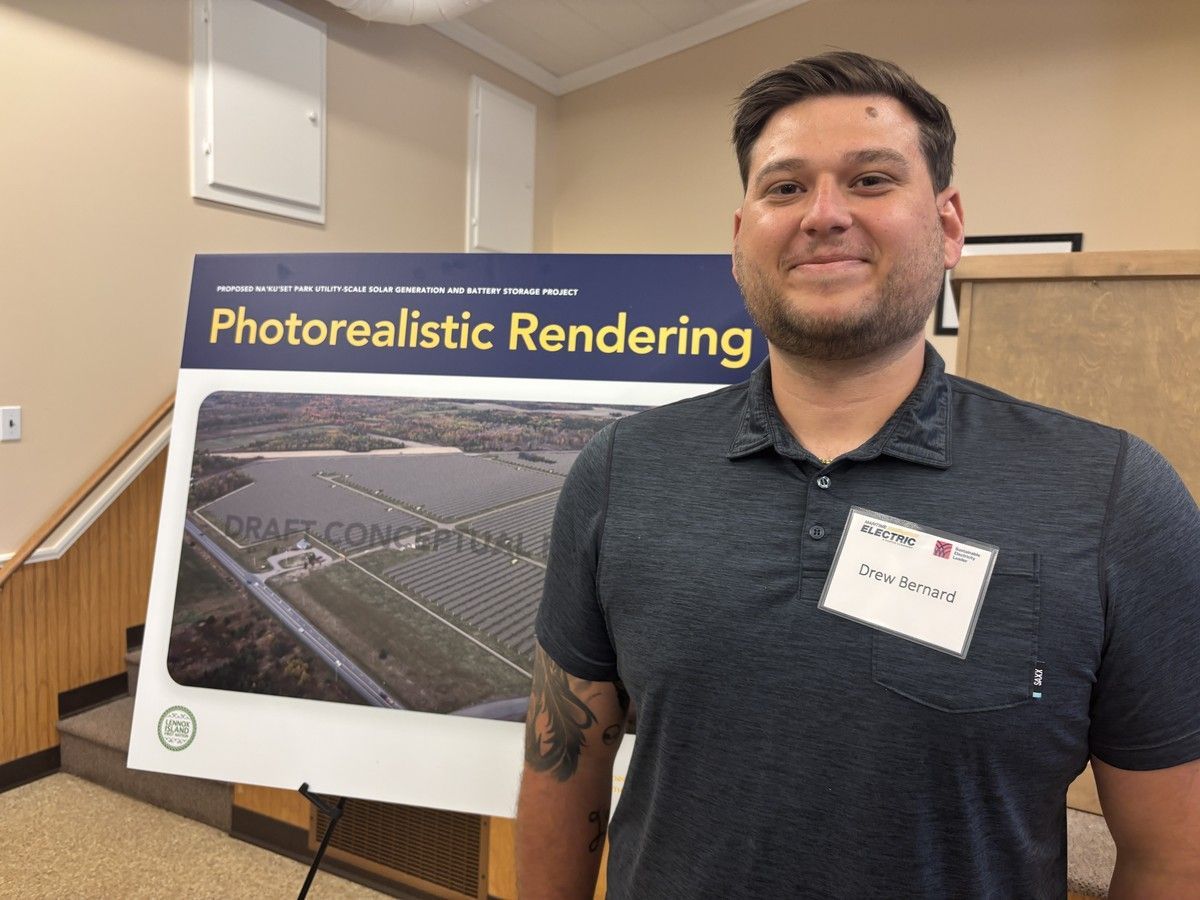
ELLERSLIE, P.E.I. — Maritime Electric and Lennox Island First Nation are collaborating on a proposed project that would provide renewable energy for western P.E.I.
On March 31, the groups held an open house in Ellerslie, for residents to stop in and learn about the Na’ku’set Park utility-scale solar and battery storage project.
Planned for the former airfield in Mount Pleasant, its 60,5000 solar panels are estimated to produce around 40,000 megawatt hours of energy — enough to power around 4,000 homes.
Drew Bernard is the energy lead for Lennox Island First Nation and has been working on their renewable energy projects for the last five years, which includes the solar park in Mount Pleasant, as well as the Wejipek Wind Project near Kinkora, and the Glenfanning Wind Project near Three Rivers.
Since the solar farm has been in development, there have been a few engagement sessions in Lennox Island, but the March 31 open house in Ellerslie was the first chance for the broader public to learn about the proposal.

Feedback thus far, Bernard said, has been positive.
“The community’s really excited,” he said. “These projects make a big difference for the own-source revenue that we’ve been generating for the community, and it’s just really, really important to the community that we are developing economic development projects like this, to be able to chart out our own path and be self-determining as a nation.”
The project, he added, will generate jobs for those in Lennox Island, both in its construction and at the park itself.
Maritime Electric is leading the project, though it is 51 per cent Lennox Island owned.
“Me, as the energy lead for Lennox Island First Nation, has been pushing these projects forward, just with the greater goal of getting our community a seat at the table,” said Bernard.
“And in terms of energy security and being able to generate positive economic development for our community, all of these projects are all part of that same vision. In the future, we hope to come back to Lennox Island and develop our own energy systems directly on Lennox Island.”

Generating power
Maritime Electric’s role in the project is the pre-development work, said Ryan Faubert, project engineer for Maritime Electric.
“We’re currently executing the environmental components for permitting, assessment for environmental impact,” he said. “We’re facilitating, with Lennox Island, community engagement sessions. So there’s jobs that are being identified for potential First Nations to be able to be trained, and then also provide meaningful careers.”
The park will power homes primarily in western P.E.I., with all the power generated remaining in the province. It has received around $1.87 million in federal funding through Natural Resources Canada’s smart renewables and electrification pathways program.

Community collaboration
Lennox Island resident Anthony Mitchell attended the open house, curious to see what the project is all about. He’s interested in this sort of power, believing renewable energy to be a benefit for not only the First Nations community, but everyone.
“It would be really great to see something of that nature produced by the First Nations community,” he said. “As well, it’s more friendly on the environment, and will be beneficial to the generations to come. Maybe they’ll be able to enjoy the environment a little bit more.”
As well, he believes it’s fantastic to not just have a project of this scale in western P.E.I., but one that is majority Indigenous owned.
“I think we need to have more projects of our own, in the First Nations community,” said Mitchell. “It’s time to step forward as a community.”

As of the open house, they were still in the midst of acquiring the land and seeking regulatory approval.
If approved, the project is anticipated to start construction in 2027, which will take around 18 months before it begins generating electricity.
“Our hopes are really to just help de-carbonize the Prince Edward Island energy grid,” said Bernard. “We just hope that we as Lennox Island First Nation have done our part to realize the goals of all of Prince Edward Island.
“If we can generate own-source revenues, that’s a positive impact to reconciliation for our First Nation, at the same time as advancing the energy goals of Prince Edward Island, that’s a win-win for us. We’re really excited to hopefully get there.”
Kristin Gardiner is a reporter for the Journal Pioneer in Prince Edward Island. She can be reached at kgardiner@postmedia.com.