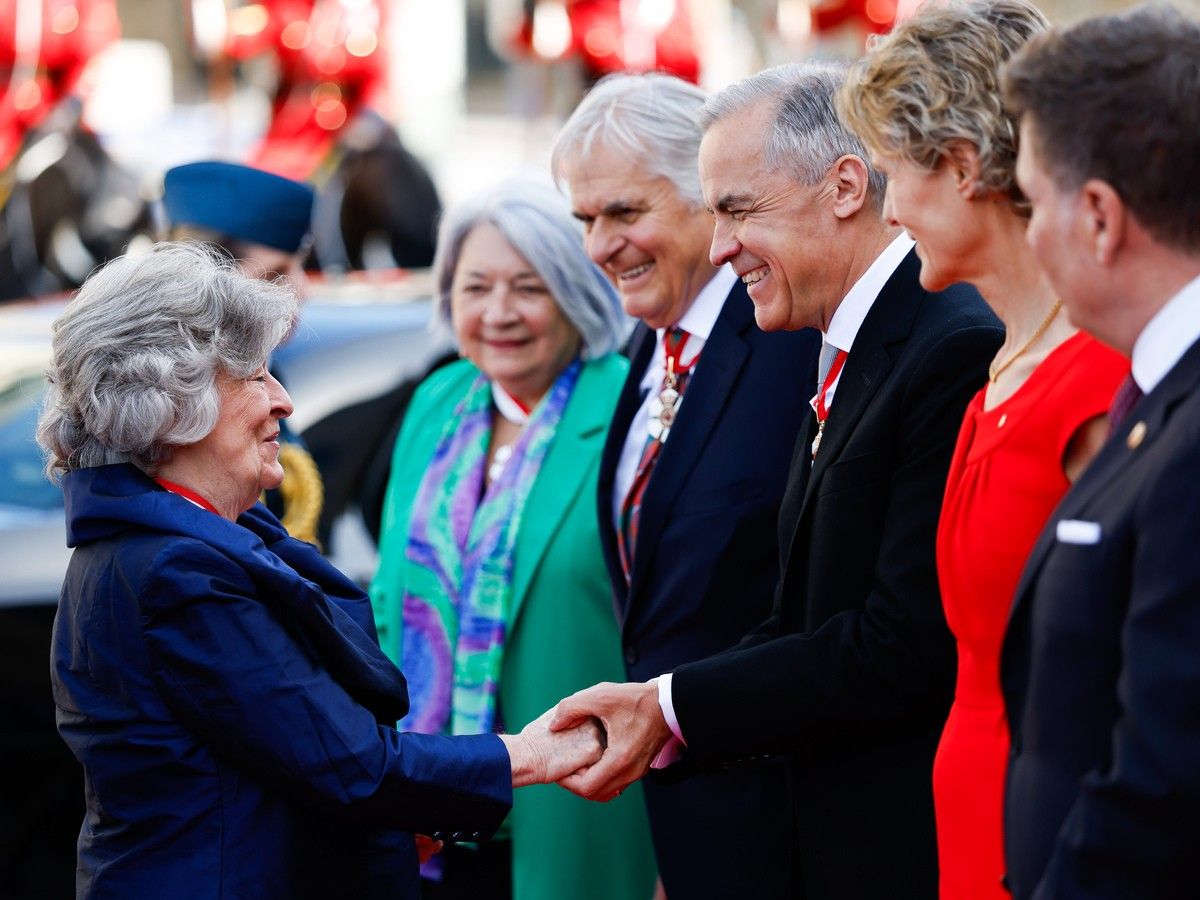
OTTAWA — Former Supreme Court justice Louise Arbour became Canada’s 31st Governor General on Monday, bearing warnings about artificial intelligence (AI) and failing Canadian youth.
Speaking in the Senate, she also spoke about the importance of embracing different points of view. She thanked Prime Minister Mark Carney and King Charles III for entrusting her with the opportunity to “serve another great Canadian institution,” along with her predecessor Mary Simon for her “remarkable service” as governor general.
In her first address to the dignitaries in the room, Arbour called on Canadians to not let the fear of differences from others stop themselves from building a better Canada.
“Extreme polarization is dangerous, but so is extreme consensus,” she said in a bilingual speech in English and French. “It is through our differences and our fundamental right to express them that we will nourish critical thinking, creativity, and innovation.”
“It is through our differences that we will build a common future.”
She said it is important to continue to protect institutions where different views can be expressed, whether they are schools, the media, courtrooms or art disciplines.
In his own speech, Carney called respect for institutions “vital” and said that is why “we are each called to share each other’s perspectives and work for our common good.”
“The Governor General is the guardian of our constitutional order, a symbol of unity, and above all, a steward of our commitment to peace, order, and good government,” he said.
Arbour, 79, said she “lived through the comfort and the discomfort of homogeneity” first being raised and taught by women in Montreal, then working in a male-dominated field as a lawyer and a judge, and finally working for human rights on the international stage.
Arbour said her work exposed her to a “great diversity of perspectives” and she built relationships with people who, at first glance, seemingly had nothing in common with.
She also shared a story about how she was confronted with her own “biases” to illustrate how easy it is to have preconceived ideas about people one may have just met.
Arbour said she was standing outside the United Nations headquarters in New York in the 1990s when she came across a group of Chinese tourists. She asked a young woman in that group about her impressions of New York, to which she replied the city is “so old.”
“I was surprised, and then I realized that I had been projecting a story onto her, imagining her as coming from a civilization of centuries-old splendour, and gazing at a vibrant city in a younger country,” said Arbour.
Arbour said she realized that young woman was more likely born in a “futuristic” city like Shanghai which would make a city like New York pale in comparison.
In her viceregal role, she said she is preparing to be surprised and confronted by her own stereotypes and unconscious biases just like at that moment.
Arbour also had stark messages to convey to the room, the first one being about inequality at a time when youth unemployment is still too high in Canada.
“Young Canadians are citizens of the world,” she said. “They’re well-educated with both deep climate awareness and remarkable digital literacy, and yet not all of them are able to reach their full potential as they face the headwinds of inequality.”
“In that, we are failing them and it is our shared responsibility to correct course.”
Speaking to young people, she called on them to create the world in which they want their own children to grow up with. “You have between your hands, like the generations that preceded you, tools that did not exist when your parents were born. So, surprise us.”
“And do not underestimate the chance that you have to grow up here, even if you are preoccupied, rightly so, by the issues of our time,” she added.
The King’s representative also notably delivered a warning about new technologies like AI at a time when the government has just unveiled its strategy on the matter.
“They’re highly attractive and widely accessible, but we must ensure that their convenience doesn’t lead us to overlook the profound societal shifts that they are driving with instant access to vast amounts of information,” Arbour said.
“AI could be threatening not only the way we live and work, but also the control we exercise over our own destiny.”
Yet, she continued, these challenges are “not insurmountable” if they are met with trustworthy public institutions, a strong education system, investments in science, research and development and with a public sector upholding standards of integrity.
NDP Leader Avi Lewis said he shares the new governor general’s fears around AI and the fears of young people “entering a world that seems designed to exclude them.”
He said he hopes Arbour’s messages about inequality are “getting through” to the government.
— With files from Jordan Gowling.
National Post
calevesque@postmedia.com
Our website is the place for the latest breaking news, exclusive scoops, longreads and provocative commentary. Please bookmark nationalpost.com and sign up for our newsletters here.