North Korea has made out handsomely amid an East-West divide.
Russia and China have sought closer military and economic ties with the hermit kingdom amid the war in Ukraine and a strategic shift away from the U.S. It’s reportedly made North Korea wealthier than it’s ever been.
Foreign visitors who returned from Pyongyang, the country’s capital, in recent years are describing signs of newfound prosperity, including restaurants serving “brick-oven pizza and chicken wings,” QR-code systems for mobile payments and Chinese EVs on the streets, not to mention “pet stores, an internet-gaming cafe and car dealerships selling BMWs,” the Wall Street Journal reported .
Likewise, families are using home-delivery apps to order take-out, people are lining up at beer-halls and car ownership has seemingly become more ubiquitous, according to The New York Times . That’s in addition to more buses, trucks and construction starts sighted across the country, according to one analyst.
Satellite imagery is also capturing nighttime lights in Pyongyang burning more intensely than in the past. South Korea’s central bank estimated that the North Korean economy grew by 3.7 per cent in 2024, the fastest growth rate in eight years. It’s a significant turnaround for a country that underwent severe food shortages during COVID five years ago, according to the Wall Street Journal, when leader Kim Jong Un was visibly thinner and shedded tears when reporting the shortages. “Almost all sectors fell a long way short,” he said at the time.

However, some 12 million North Koreans out of a population of 27 million are undernourished, according to the UN. And the heavily sanctioned centralized economy reported a trade volume of only US$2.7 billion in 2024. Due to multiple sanctions on trade, fake hair and wigs are North Korea’s primary export, most of which goes to China. By comparison, South Korea’s economy, at US$1.86 trillion, is almost 70 times bigger, according to Germany’s public broadcaster DW.
The Bank of Korea attributed North Korea’s GDP growth to increases in manufacturing, construction and mining industries, citing a military and economic cooperation pact with Russia signed in 2024.
Following the landmark mutual defence pact, North Korea has supplied Russia’s war effort with unprecedented resources and manpower. It deployed more than 15,000 troops to western Russia, South Korea’s spy agency reported in 2025. The troops have suffered a casualty rate of about one in three, according intelligence officials. North Korea has also shipped large amounts of artillery, missiles and ammunition to its northern neighbour and received food, military technology and energy in return.
North Korea has collected up to US$14.4 billion from these dealings, a Seoul-based think tank reported earlier this year.
The state coffers are also lined by North Korean hackers, who account for the bulk of global crypto thefts, according to analysts. North Korean workers also send money home from foreign countries, notably China. Train service between Beijing and Pyongyang resumed this year after closing during COVID. North Korea has reportedly shown more willingness to open its borders to allies.
North Korea’s deepening ties with Russia has provided it leverage in discussions with China, which has been Pyongyang’s biggest trading partner for decades. Experts say China would like to keep it that way.
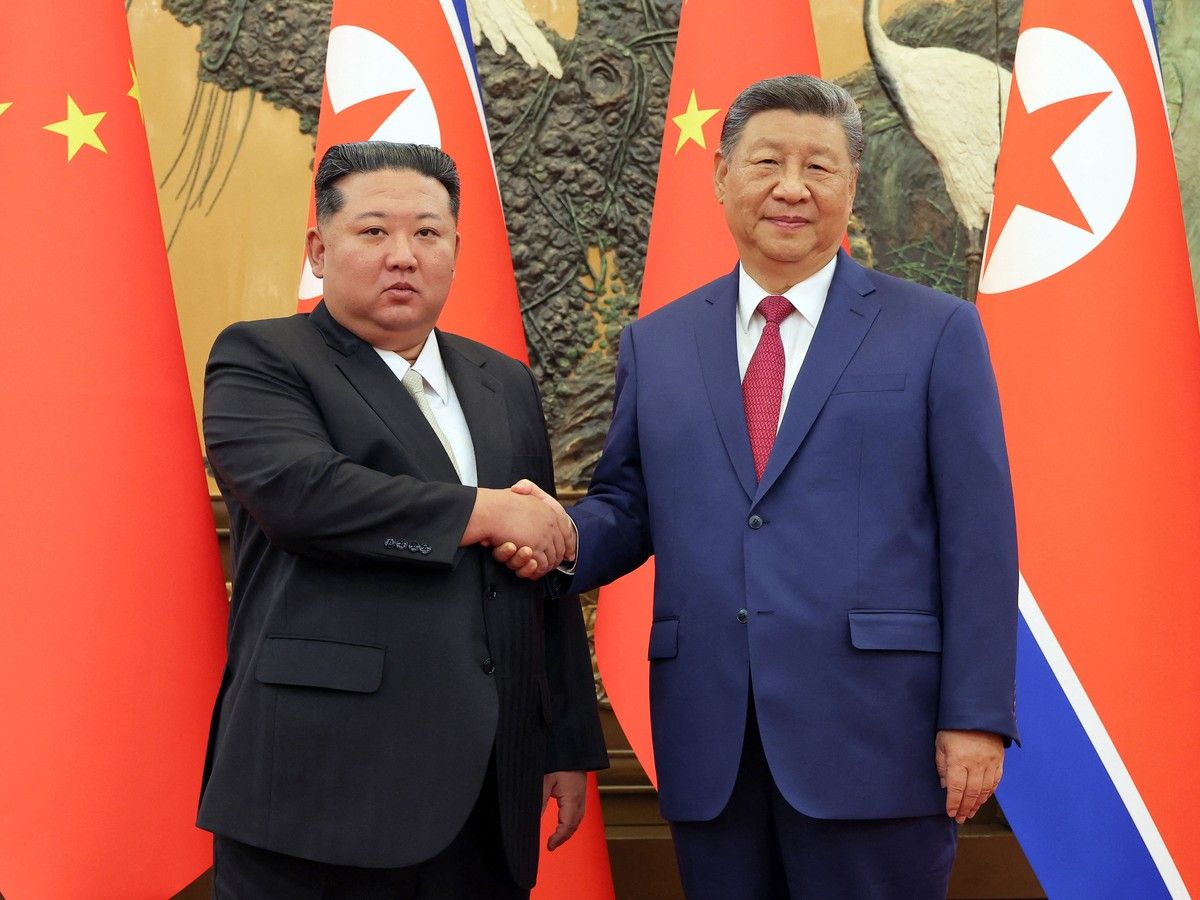
On Monday, President Xi Jinping made his first visit to North Korea in seven years. In that time, North Korea has ramped up testing of intercontinental missiles. Last week, while unveiling a new nuclear facility, Kim said that North Korea’s production of weapons-grade nuclear would be “exponential” and that production capacity had more than doubled in five years. A day before Xi’s trip, Kim’s sister, Kim Yo Jong, said the country’s atomic weapons program was “absolutely non-negotiable” and that “officials in the United States have failed to wake from their escapist and anachronistic dreams,” according to Bloomberg.
The Xinhua readout of the meeting made no mention of eliminating nuclear weapons on the Korean Peninsula — a goal China had maintained publicly for years. That language has been missing from official Chinese statements since Kim’s visit to Beijing last September, prompting speculation that China has now tacitly accepted North Korea as a de facto nuclear power.
The new coalition was evident in Beijing last September, during a military parade marking the 80th anniversary of the end of the Second World War, where Kim and Russian President Vladimir Putin stood flanking Xi.
National Post, with a file from Bloomberg
Our website is the place for the latest breaking news, exclusive scoops, longreads and provocative commentary. Please bookmark nationalpost.com and sign up for our daily newsletter, Posted, here.